
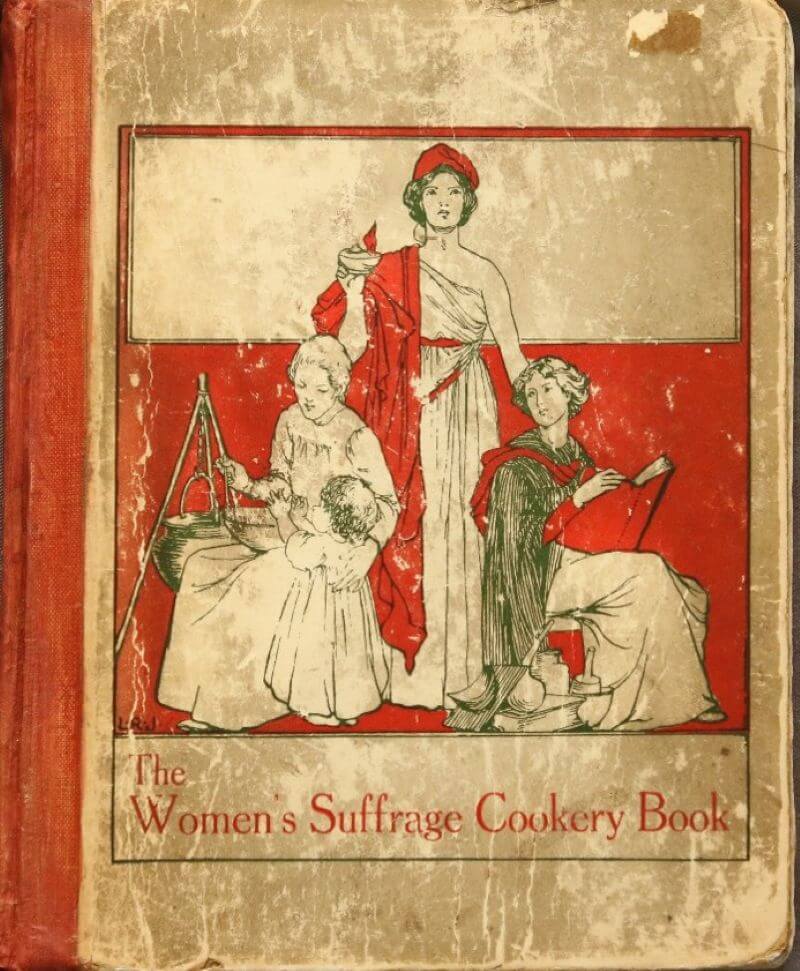
The Women’s Suffrage Cookery Book – edited by Mrs Aubrey Dowson and published in1909 by The Women’s Printing Society
The chance find of a contribution by local suffragist to the Women’s Suffrage Cookery Book, led Amersham Museum to acquire a copy of the book with help from the Friends of the Nations Libraries. Two recipes and a knitting pattern had been included from a Miss Julia Sharpe living in Great Missenden in 1909. This article looks at how the cookery book came into being, its links to The National Union of Women Suffrage Societies (NUWSS), and The Women’s Printing Society which had been set up by women for women workers as early as 1876.
You might be wondering whether a suffragist was the same as a suffragette. They were in fact two different groups and whilst they shared the same aims, principally centred on votes for women and an expansion of women’s rights, the difference lay in their approach. Suffragists used peaceful methods, lobbying politicians and holding public meetings and the NUWSS was formed in 1897. Millicent Fawcett was one of the main proponents of the suffragist cause. Meanwhile the Women’s Social and Political Union (WSPU), formed in 1903 and frustrated by the lack of progress on women’s rights adopted a more radical approach often with violent campaigns of disruption, civil disobedience, arson and when arrested, hunger strikes in prison. Their approach of ‘deeds not words’ was spearheaded by Emmeline Pankhurst. In 1906, a journalist writing in the Daily Mail coined the term suffragette as a derogatory name for the WSPU, to ‘indicate that special revolutionary quality of impatience which marked the new variety of suffragist’. However, the WSPU adopted the name as a badge of honour. The division in approaches between the two groups caused a schism as the suffragists were very concerned that the actions of the suffragettes would damage the common aim.
The Book – The Women’s Suffrage Cookery Book
In 1909, NUWSS was looking for different ways to raise funds for the suffrage cause. One of their members, Mrs Aubrey Dowson, the secretary of the Midland Federation of Suffragists, suggested an idea which had already been successful in America, a cookery book with recipes and household hints supplied by members. Mrs Dowson announced the availability of the intended book in The Common Cause, the newspaper of the NUWSS in the summer of 1909 with a request for contributions.[1] In addition to local contributions, recipes for Potted Hare from Madame Alexandre of Touraine, France and Preserved Orange Balls from Frau Wilbrant, Heiligenblut, Carinthia in Austria give an indication of links to suffragists in other countries.
The Women’s Suffrage Cookery Book was published in November 1909 by the Women’s Printing Society – an interesting organisation which we will return to shortly. The book measured 6 ½ by 8 inches with 77 pages covering recipes by mealtime, but also included sections on butter making, stillroom recipes and invalid cookery. On the 18th November, a review of the book in The Common Cause, stated that:
Mrs. Aubrey Dowson has edited a cookery book containing 230 cookery and stillroom recipes by Suffragists. It is published by the Women’s Printing Society in paper boards, price Is. 3d. post free, and can be obtained from Mrs. Aubrey Dowson, Yew Tree Cottage, Lapworth, Warwickshire, or Miss E. M. Gardner, 10, Easy Row, Birmingham. The recipes are good, and some of them distinctly original. The proceeds of the sale are to go to the National Union.[2]
Mrs Aubrey Dowson was in fact Phillis Dowson. Being known by your husband’s name was the convention of the time, but many feminists ignored this convention and used their own names. So why did Phillis deliberately choose to be known as Mrs Aubrey Dowson? The answer lays in the fact that Aubrey was a famous international rugby player. Likewise, another contributor, Dora Russell, chose to be known as Mrs Bertrand Russell. Both recognised that using that their husband’s names would gain added publicity and implied public endorsement of their activity as suffragists, which would be of value to the cause.
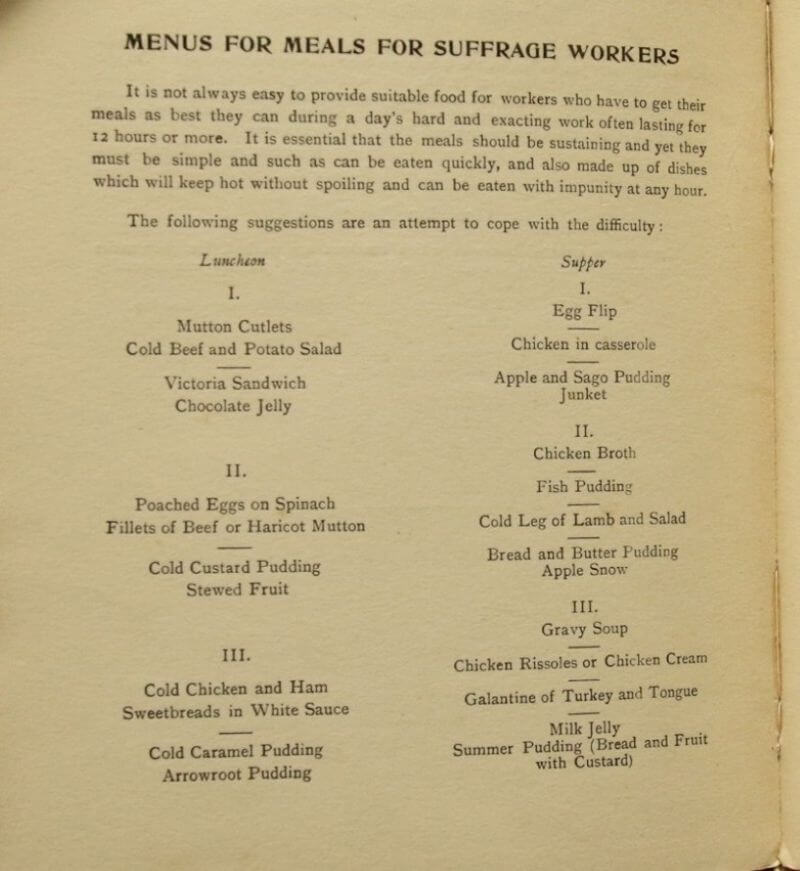
Whilst the book had an objective of fund raising, just as importantly it was intended to provide quick and simple dishes for women to prepare for their families, leaving them more time to campaign for the cause. In addition to recipes, the book included ‘Menus for Meals for Suffrage Workers’ with a selection of dishes that ‘must be simple and such as can be eaten quickly, and also which will keep hot without spoiling and can be eaten with impunity at any hour’. However, in keeping with the time, supper still consisted of three or four courses! The recipes are notable, not only for their simplicity, but by the limited amount of information on cooking. A warm or hot oven are recommended, not the detailed information on cooking temperatures that we are used to. Ovens with precise temperature controls had yet to be invented and cooking was based on experience and cooking times left to judgement. Among the contributors with recipes and a knitting pattern was a local suffragist, Miss Julia Sharpe of Great Missenden.
Since suffragists relied heavily on public meetings to get their message heard, prominent speakers were very important for their cause, and the book was not without humour on the point. Dora Russell added a ‘Recipe for cooking and preserving a good suffrage speaker’! Advice was given on how to ‘butter the speaker, when asking her to come’, ‘grease the dish by paying all the speaker’s expenses’ through to not letting ‘her cool too quickly after the meeting, but place her considerately by a nice bedroom fire’.

The household remedy section had a wide range of hints and tips, some very useful such as this recipe for stewed raspberries:
To make a really delicious dish of “stewed raspberries” don’t stew them! Make a rich syrup with red currants and sugar and place the raspberries in it uncooked.
Mrs Robie Uniacke, Andover
Whilst others were slightly dubious.
For Strained ankle or wrist
Brush the part affected with raw white of egg, this will harden and form a crust. Repeat every half hour about six times. In the morning the swelling and pain will probably have almost disappeared.
Miss Mabel Thomas, Bristol
Among the recipes submitted by local resident Miss Julia Sharpe were Almswood Pudding – a type of sponge with ‘a little flavouring’, a Fruit Juice Mould, and in the household section, instructions on how to knit a baby’s blanket which assumed a reasonable level of knitting proficiency.
Although this appears to be the first suffrage cookery book published in the UK, in America, The Woman Suffrage Cook Book was published in Boston in1886 and compiled by Hattie A. Burr.[3] As with the later UK version, the book was published to support fund raising and included traditional recipes with contributions from famous suffragists and professional women. Further regional books included Washington Women’s Cook Book published by The Washington Equal Suffrage Association and edited by Linda Deziah Jennings in 1909, and The Suffrage Cookbook published by The Equal Franchise Federation of Western Pennsylvania and edited by Mrs. L.O. Kleber in1915.[4] The NUWSS cookery book was reprinted on at least one other occasion and a second edition with a different cover was published, most probably in 1912, as further adverts appeared in The Common Cause throughout the year.

2nd Edition of the Cookery Book, 1912
The Publisher – The Women’s Printing Society
Research into the Cookery Book also led to a printing company which had been set up by women for women workers. By the time the Women’s Suffrage Cookery Book was published, the Women’s Printing Society had already been in existence for thirty three years. Formed in 1876 in Holborn, London by Emma Patterson and Emily Faithfull, its objective was to train women to work in the printing trade. Emily Faithful had previously founded the first female-run printing house in the UK called the Victoria Press in 1860 which had published women’s writing focused on gender inequality and social justice. Emily Faithfull soon obtained a reputation for her excellent work and was appointed printer and publisher to Queen Victoria. Some of those involved in the Victoria Press joined Emily and Emma in setting up the Women’s Printing Society.
The Englishwoman’s Review of September 1876 stated:
The Women’s Printing Society which has lately been established in temporary offices, Castel Street, Holborn, offers special advantages to girls desirous of learning the business. Many parents who would feel scruples about apprenticing their daughters to an ordinary establishment where most of the employees are men, might be willing to send them to instruction here, especially as several ladies of position are on the Board of Directors. In 1871, there were 741 female printers in England, according to the census.[5]
The women worked mainly as compositors or typesetters and by 1899 the organisation employed twenty two women. Three of the seven Directors were women and most of the management positions were held by women including the proof-reader and bookkeeper. However, a few men were employed to carry out the heavier work. An article printed in The Examiner later in 1876 explained:
After a month’s trial, the girls enter upon a three years’ apprenticeship, during which small but increasing weekly wages are paid. It is proposed that the women employed by the Society shall, when they are competent workers, receive the ordinary trade rate of remunerations, so that any unfair competition with men’s work may be avoided.[6]
In addition to paying a competitive wage, the Society was also progressive in terms of rewarding employees for their part in the success of the company by operating as a cooperative. In years where there were good profits, not only did the Directors receive a dividend, but all employees received a bonus based on a percentage of their annual salary. Initially this was paid at 5%, but by 1900 this had increased to 10% and in 1903, it reached 13%.
As the suffragist movement grew in the latter part of the nineteenth century, the company played an increasing role in printing suffrage literature in addition to the female directors taking an active part in national suffrage meetings. Although supportive of women’s causes, the company was a commercial concern and took on all types of printing work which proved to be extremely successful. By 1906, the business had increased to the point where the Society had outgrown its premises and decided to build a new works and offices. A site was found in Brick Street, Piccadilly and a three story building, complete with a roof garden, was constructed at a cost of £3,500.

Inside the workshop of the Society in 1912[7]
A review of the history of the Society in The Vote in April 1921 noted that still much of the work undertaken ‘includes publications of various women’s societies, the Women’s Engineering Society, the National Union of Societies for Equal Citizenship, London Society for Women’s Service, Women’s Institute, Women’s Local Government Society, National Political League and the South London Hospital for Women’.[8] Interestingly, despite supporting employment rights, ‘it does not pay Trade Union Wages to the women, for if it did it would have to assimilate all the conditions to those of men’. It noted in 1921 that ‘girls are usually apprenticed from 15-18 years of age, during which they receive a wage of 12s. per week. rising by annual additions of 2s. The hours worked are 46 1/4 per week’. Pursuing an independent approach, the Society was able to fix hours of work more suited to women, reduced overtime compared to men, offer a considerably shorter apprenticeship programme and to keep women on ‘during slack times’.
Along with many feminist pamphlets and tracks the society published were several influential books on suffrage and women’s rights:
Education of Girls in Wales by Frances Hoggan (1879)
What is women’s suffrage and why do women want it by Veritas (1883)
A Woman’s Plea to Women by Elizabeth Clarke Wolstenholme Elmy (1886)
Home Politics: An Address by Millicent Garrett Fawcett (1894)
Women in India and the Duty of their English Sisters by Mrs. Martindale (1896)
Woman Suffrage and the Anti-militants by Ennis Richmond
Choose, Ye: Darkness or Light! by Lady Melville (1922)
The Women’s Printing Society continued to operate out of Brick Street, finally closing in the early 1950s after over seventy five years in existence.
Footnotes:
[1] The Common Cause, 29 July 1909, p.10.
[2] The Common Cause, 18 November 1909, p.10.
[3] Mrs Hattie A. Burr, Ed, The Woman’s Suffrage Cookbook, (Boston, 1886).
[4] Linda Deziah Jennings, Washington Women’s Cook Book, (The Washington Equal Suffrage Association, Washington,1909): Mrs L.O.Kleber, Ed, The Suffrage Cookbook, (The Equal Franchise Federation of Western Pennsylvania, Pittsburgh, 1915).
[5] The Englishwoman’s Review, 15 July 1876, p.28.
[6] The Examiner, 11 November 1899, P.22.
[7] Northern Echo, 5 Sept 1912, p.7.
[8] The Vote, 22 April 1921, p.5.