A surprising enclave of mid-century modernism
By Alison Bailey

One Sunday in 1959 a young architect, Monica Mullins, spotted a small ad in the Observer newspaper. This offered a plot of land for sale in Buckinghamshire, on which the successful applicants could build “a contemporary house”. At the time Monica was living in a flat in Dulwich with her new husband, William, usually known as Bill, who was also an architect.
Monica answered the ad and discovered that the plot of land was in Cherry Lane just off the medieval high street of Old Amersham. The plot was part of the extensive walled garden of a house with a Queen Ann façade known as The Firs, now Piers Place. John Wallis, who had placed the ad had already received several offers for the land but was disappointed that all the applicants wanted to build a conventional house there.
In 1957, John and his wife, Dorothea, had already completed their own home, Red House, designed by the Hungarian émigré architect Ernö Goldfinger, who was a key figure in the Mid-Century Modern “Modernist” Movement. Goldfinger’s initial design, featuring a flat roof with a projecting timber-clad water tank, however proved too controversial for Old Amersham and was rejected by Amersham Rural District Council.
Piers Place

When they came out to Old Amersham, Monica and Bill Mullins immediately saw the potential of the plot to create their dream home and garden. However, before tackling the planning department they had to convince John Wallis that they did not want to build a conventional house and that they shared his interest in contemporary architecture. Both Monica and Bill worked at the London practice Richard Sheppard and Partners, which had a reputation for innovative design. Bill had won a scholarship to the Architectural Association School, which was at the forefront of modernism in the UK. He was acclaimed for his 1955 design of the Weeks Hall, and Southside Halls of Residence for Imperial College London. Built in innovative precast concrete and glass, these were subsequently Grade II Listed.
However, John Wallis did not actually own the land and they also had to convince the owner, Dorothea’s guardian, the formidable Margery Abrahams to sell them the plot. Miss Abrahams had divided Piers Place into two separate dwellings, the main house, and the stables and created two building plots on the extensive burgage land behind the formal garden. One plot for the Wallises and one to be sold. Luckily Miss Abrahams was also passionate about modern architecture and agreed to sell to the young architects. As part of the negotiations to buy the land, it was agreed that the new house had to be in line with Red House (to ensure uninterrupted views of the gardens from Piers Place) and that the Wallises and Miss Abrahams were to be consulted about the final design.
Vine House

Monica worked on the drawings for the house, but pregnant with their first son, credits Bill with the design. At the same time Bill was working on the practice’s winning submission for a competition to design a new college at Cambridge University. It is therefore no surprise that the house shares many design details and materials with Churchill College. The college became a full-time commitment for the next five years and on completion, was Grade II Listed. In 2017 Churchill College recognized Bill’s contribution by making him an Honorary Fellow.
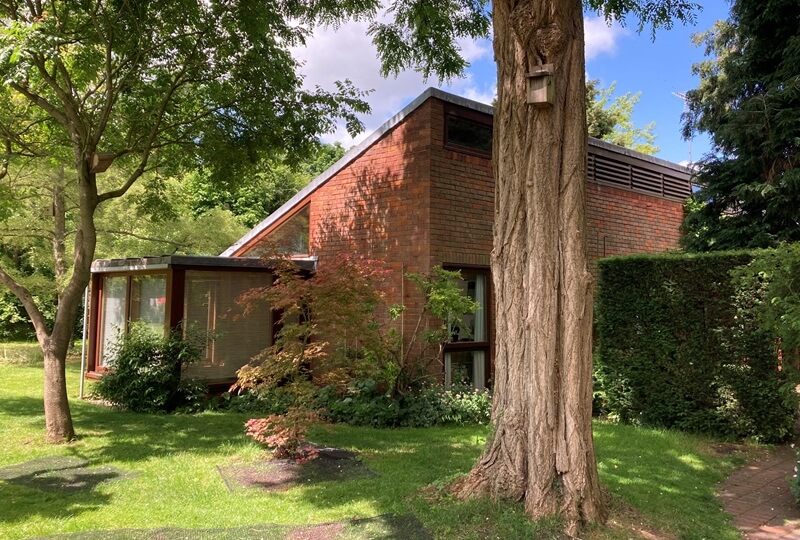
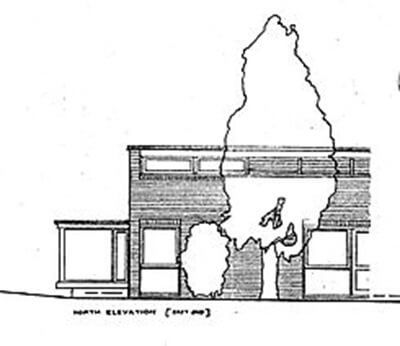
The Mullins were inspired by Scandinavian architects like Alvar Aalto and Arne Jacobsen. After the earlier controversy over the proposed flat roof on Red House, they chose a mono pitch for the living rooms and bedroom wing. Despite the contemporary design the plans were passed without opposition by ARDC. The build went ahead, and in 1961, the Mullins moved into the new house which they named Vine House after their newly planted grapevine.
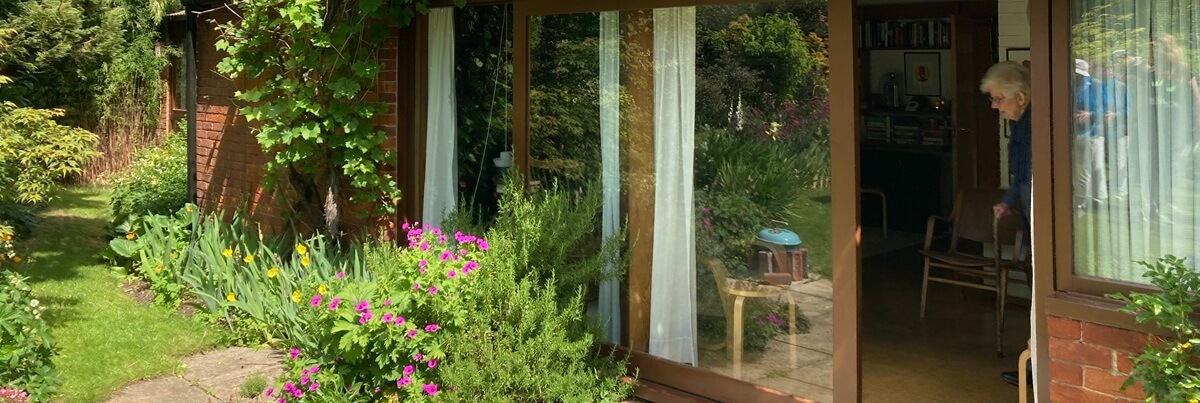
Over 60 years later Vine House is unchanged and still feels fresh and innovative. The use of natural materials, clean angular lines, and its minimalist aesthetic are all typical of a Mid-Century Modern house. The open-plan living area has a sense of spaciousness which is increased by the unusual angle of the roof and the expansive glazing. The generous amounts of light and views of the lush foliage outside succeed “in bringing the outdoors in”, a key feature of Modernism.