
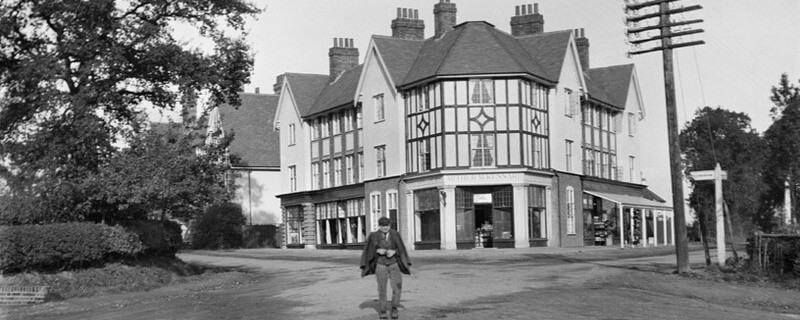
The development of Amersham-on-the-Hill, which contains the majority of the town’s shops, its last bank, the Chilterns Lifestyle Centre, and its civic centre, including the police and law courts, began in 1892 with arrival of the Metropolitan Railway.
The local landowner Thomas Tyrwhitt Drake had finally agreed to sell the railway company some of his land. As he did not want to be able to see the line from his manor at Shardeloes, he sold the railway some of his Hyrons Farm land on Amersham Common, nearly a mile above the existing town. Amersham Common stretched from Hyde Heath to what is now Little Chalfont with a scattering of farms, labourers’ cottages and public houses. It joined Chesham Bois Common to the north.
Some of the earliest buildings in ‘New Town’ or ‘Top Amersham’ were Weller’s Station Hotel and the Temperance Hotel to cater for every traveller’s needs! Initial development was slow because of the lack of a mains water supply, but this speeded up after the completion of the water tower at Coleshill in 1915.
Amersham-on-the-Hill has its own character, with some fine Arts & Crafts buildings, mainly by architect John Harold Kennard, such as The Avenue and the landmark development, Oakfield Corner. The conservation area, Elm Close, was built by Kennard in 1920 with government subsidies as part of the Addison Act “Homes for Heroes” policy and is constructed with innovative concrete blocks and cement roof tiles.
The International Tea Co. and Stores was the first national chain to move into the new town at Station Parade and was a real vote of confidence in Amersham-on-the-Hill. The main shopping streets in the new town, Hill Avenue and Sycamore Road gradually developed as a mix of houses and shops with several grocers, dairies, fishmongers, butchers and tobacconists. Chiltern Parade, the 1936 J Sainsbury development, with a Sainsbury counter store at the centre of the parade attracted other national chains to the town such as Boots The Chemist and the Freeman Hardy and Willis shoe shop.
1930s architecture such as the distinctive Chiltern Parade on Sycamore Road, the bank at Oakfield Corner and the modernist estate agents on Hill Avenue help give this area a distinctive Metroland feel, a term coined by the Metropolitan Railway’s marketing department to encourage workers to move out of London along the railway line. The town features in the 1973 John Betjeman documentary Metro-Land about the growth of suburban London in the 20th century.
One of the first self-service supermarkets (where you could choose your own purchases from the shelves) the Maypole, arrived in the area in 1961 on the site of the recently (and tragically) demolished Art Deco Regent Cinema. This was built in 1928 by builder Alfred Woodley and Walter Collins, a professional musician and composer. In 1981 Catherine and Gary Grant, took over the Pram and Toy Bar in Sycamore Road which became the first Entertainer toy shop. Today it is the UK’s largest independent toy retailer and operates more than 170 stores.
During WWII, a thriving Jewish community of evacuees and artistic émigrés developed in Amersham-on-the-Hill and Chesham Bois, and a Synagogue was founded on Woodside Road. Sally Latimer and Caryl Jenner’s Playhouse Theatre, at the top of Station Hill, launched many famous actors’ careers, including Denholm Elliott and Dirk Bogarde.
See the left hand column (or below on mobile devices) for buildings or streets to visit