
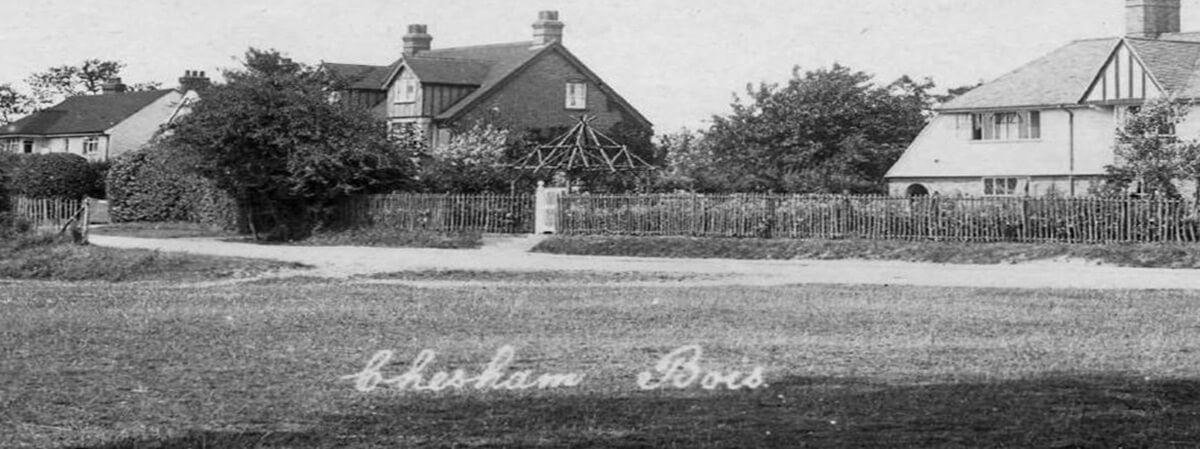
This is the story of an Edwardian villa, Orchard House on Chesham Bois Common.
By Alison Bailey
House Histories
At Amersham Museum we often receive enquiries from residents wishing to know more about the history of their home. Details about properties in Old Amersham, and a limited number in Amersham-on-the-Hill and Chesham Bois are available on our website. However, the museum only has a small archive at present, although we are always keen to add to it. Where information is known we endeavour to add it to our website and would love to hear more about your house if you have carried out your own research. Genealogy websites and online newspaper archives are a valuable source of information; however, the property’s deeds and indentures contain a wealth of material, and we would recommend starting here, where possible. Buckinghamshire Archives, who offer a free virtual or in person service, may also be able to help.
Manor Farm

Orchard House is built on land, known as How’s Orchard, which was once part of Manor Farm North Road. This was one of the farms belonging to the Manor of Chesham Bois and owned by the lords of the manor until the Duke of Bedford sold much of his land in Chesham Bois in the early 1800s. In 1884, local landowner and brewer, John Hailey Morten, bought the farm as an investment realising that the imminent arrival of the railway to the neighbourhood would see a rapid increase in the price of land. Having been proved correct, he sold 60 acres of the farm, bordering Chesham Bois Common, in 1896, to Arthur Lasenby Liberty, the founder of the Liberty department store.
After dividing the land into building lots of different sizes, Liberty sold the land just a few months later at auction at the newly built Railway Hotel in Amersham. The orchard was bought for £470 by Dr Frederick Mott, an eminent London physician and psychiatrist, who had recently bought the Old School House on the corner of Bois Lane and Chestnut Lane, as a weekend retreat for his family. He was created Knight of the British Empire in 1919 in acknowledgement of his war services in the Royal Army Medical Corps and for his pioneering work on shell shock.
The Payne family
Dr Mott didn’t develop the orchard although he also appears to have made a handsome profit in 1905, when he sold it for £1,600 to the magnificently named Ebenezer Deverell, a bank manager from Chesham. By the following year Plots 2 and 3, a piece of land 100 ft by 350 ft fronting Chesham Bois Common was owned by John Payne. In the indenture he is described as a ‘gentleman of Hirons Farm’. Local builder, William Gomm, was commissioned to build an Edwardian villa with 12 rooms on Plot 3, with a large garden for growing vegetables and keeping livestock. A lane at the back of the property provided carriage access.
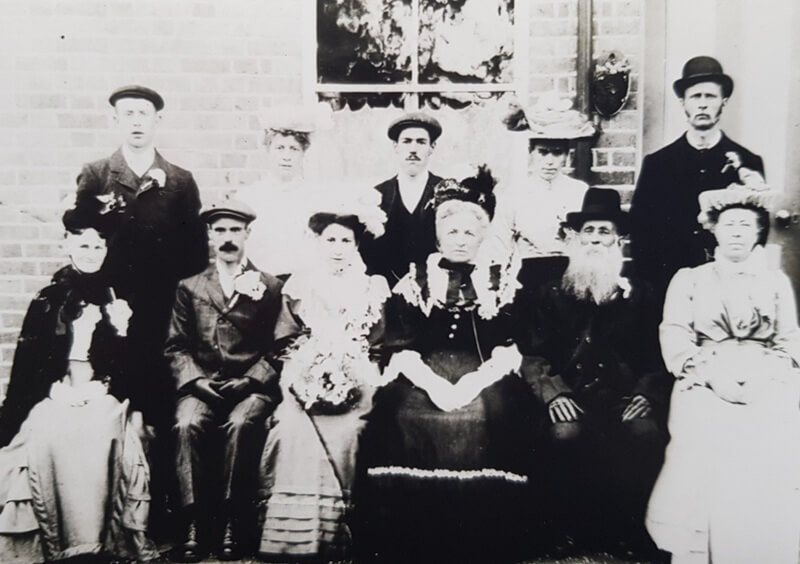
John was 69 when he built the house with his wife Ann (née Cyster). Born in Seer Green, he had worked as a chairmaker before settling at Hyrons Farm on Amersham Common. Part of the farm was sold by the landowner Thomas Tyrwhitt-Drake to the Metropolitan Railway in 1887 with the remainder of the land later sold as building plots. As tenant farmers the Paynes presumably were owed compensation. As well as buying the land for Orchard House they also bought land on Bois Lane for two further houses, and a shop.
The Paynes had eight children and their youngest child, Susan, married Peter Pontin, the local carter and also set up home in Orchard House. Their first children, Ivy and Minda were born at the house in 1908 and 1910, before the family moved down the road to Sunshine House, next door to Susan’s older brother John and his family.
Boarding House

The properties were subdivided into apartments and letting rooms. According to the 1911 census for Orchard House, Ann employed one servant, Emily Pearce, age 24 to help her. Ann died in 1916, and John moved down the road to live with his daughter. He died there four years later and the property was sold.
The property continued as a boarding house, and from 1922 was owned and run by two unmarried sisters, Catherine Anne Sage, 57 and Caroline Rosa Sage, 55 from Berkhamsted. The sisters advertised their letting rooms as “well-furnished apartments; good cooking; bathroom; electric light; garage”.
Ingersoll the watch makers bought the house in 1941. They also let rooms but now provided accommodation for their employee, Reginald Thomas Nutter, and his family after they were bombed out of London during the Blitz. The Nutters liked the area because when the property was sold in 1945, they bought the side garden and built a new house, Seclusion.
The Pantons

For the first time in its history, Orchard house now became a family home. Alistair Maymott Vivian Panton, a solicitor in London, moved to Orchard House from neighbouring Manor Drive, with his wife Patricia and their two sons Patrick and Ian. A third son, Christopher, and a daughter, Lyn were born whilst the family lived at the house.
Alistair was a keen model maker. During the war he made models of the underside of military aircraft to help searchlight crews differentiate between enemy and friendly aircraft. He continued with his hobby at the new house, creating a model railway which ran the around the garden. Patricia worked as a listener for the Radio Security Service, MI8 in WWII. Initially based at Wormwood Scrubs, their role was to ‘intercept, locate and close down illicit wireless stations operated by enemy spies in Great Britain’. Family tradition has it that she listened to the conversations of the exiled Duke and Duchess of Windsor.

In 1947, Patricia, an extremely athletic and active lady, pregnant at the time with Christopher, fell dangerously ill with polio. She was in hospital in Oxford for several months and Christopher was born there. When she returned to Orchard House, she had to use a wheelchair and was unable to go upstairs. A downstairs reception room was turned into her bedroom, and a nurse was employed who lived on the top floor with her own kitchenette.
The family’s many pets included black Labradors, cats and more unusually Indian runner ducks! The ducks had a tin bath in the back garden but soon discovered Bricky Pond on the Common. According to Christopher: “The ducks were a big part in our lives and most nights I had to stand in the pond opposite the house trying to get them in or they would be eaten by foxes. I clearly remember getting dressed up to go out for the evening and Mom would shout “Get the ducks in before you go”. I would then be found standing in the pond +with the water coming over the top of my wellington boots!”
The Panton boys all attended the Beacon School where the headmaster was extremely sympathetic to the family situation. Pip Masters frequently forgot to send bills for school fees and lent them his car when they needed a holiday. Christopher, who later became a driving instructor, said that all three boys learnt to drive in the headmaster’s car doing handbrake turns in the back garden.
Christopher said: “One very hot summer my father, brothers and I decided to build a swimming pool in the back garden, right down the bottom. We dug an enormous hole just with spades and lined it with black plastic sheets. It took hours to fill so the tap was left on all night. We eagerly rushed down next morning for our first swim to find it full of our Indian runner ducks! They had ruined it and filled it up with duck poo. It was still hot and I do remember us swimming in it – it doesn’t seem to have done us all too much harm.”

“I have nothing but happy memories of my time at Orchard House. We seemed to spend the entire time playing outside. My dear mother did everything for us and we just took it for granted that she would never walk but it made no difference. A very, very happy childhood. In fact, it is lucky that the house is still there – re-enacting the Battle of Britain, we used to set fire to model Airfix aeroplanes and throw them burning out of the top windows. One landed on a flat roof so, being the smallest boy I was hoisted up on to the roof to put the flames out. It was lucky the house wasn’t burnt down. No doubt my mother was busy cooking our lunch!”
David James, who lived in Beech Barn Camp after WWII remembered with great fondness visiting Orchard House when his mother cleaned there. He described the Pantons as a lovely family and presumed that Alistair had been a champion rower as there were half a dozen large oars upon the wall of their front room. He wrote: “The first time I went to the big house I recall how amazed I was to see that the lady’s two sons had a room where the floor was absolutely covered with toy soldiers, tanks, guns, trucks, ships, and, suspended from the ceiling on wires, many model airplanes. I could only stare in wonder. Of course, Mum strictly forbade me to touch anything, but I was quite happy to stand by the door and look. Later, when the boys were home, they’d invite me into their thrilling playroom and we’d play for hours together. Indeed, I confess that sometimes I didn’t want to go home”.
The Abbeyfield
Orchard House was sold to the Abbeyfield Society in June 1970 when the Pantons moved to Coleshill. Land was sold at the rear of the property for further development, and the house was converted into a residential home for the independent elderly.
Geoffrey Francis Alcock Grubbe was a resident for more than 15 years He was well- known in the village as a talented gardener and had spent his childhood two doors down at Killaspy, his grandparents’ home. He was instrumental in the reconstruction of the Chesham Bois Common pond in 1995.
In 1999 new regulations meant that expensive renovations were needed and the house was sold, becoming once again a family home.

Sources
- Owners’ deeds
- Ancestry
- British Newspaper Archive