

From Whodunnits to Carry On Nurse an extraordinary life
By Alison Bailey
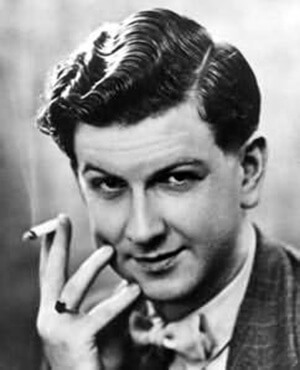
“A good-looking young man with crisp, curly fair hair and big light-blue eyes. Laziness, and self indulgence, had thickened his neck, had fattened his cheeks and chin, blurring, like a gauze, their original fineness, but he remained unusually personable in spite of that. His tastes were literary; his conversation was witty; his manners were impeccable. And by the end of the first five minutes of their acquaintance, Fen detested him.” This is a description of a character in a Gervase Fen detective story, The Golden Mean by Edmund Crispin. It is also a humorous, miniature self-portrait of Bruce Montgomery, who used the pen name Edmund Crispin for his series of ‘whodunnits’, which often feature this self-deprecating sense of humour.
The critic Anthony Boucher once described Edmund Crispin as the master of fast-paced, tongue-in-cheek mystery novels, a blend of John Dickson Carr, Michael Innes, M.R. James, and the Marx Brothers!
When asked about his hobbies, Crispin used to say that what he liked the most in the world was “swimming, smoking, reading Shakespeare, listening to operas by Wagner and Strauss, wandering around and looking at cats. On the contrary, I felt great antipathy for dogs, French films, modern English films, psychoanalysis, psychological and realistic detective novels, and contemporary theatre”.
Bruce Montgomery

Multi-talented (Robert) Bruce Montgomery was born in Chesham Bois in 1921. He wrote his first novel as a 23-year-old undergraduate at Oxford in 1943. He probably chose to use a pseudonym because he wanted to save his real name for his work as a composer and musician. He had already published some compositions, and was in great demand as a conductor, piano accompanist, and organist. Before he was 40, he had published eight detective novels, one book of short stories and edited several collections of Science Fiction which helped to establish the credibility of the genre. He had completed around 100 compositions of choral and orchestral work, organ music, incidental music for radio and numerous film scores.
He composed music for many of the British comedies of the 1950s including the Doctor in the House series and the first Carry On films. The march composed for Carry On Sergeant became the series theme tune. His distinctive march for Hattie Jacques’ matron in Carry On Nurse was comedy gold and will be familiar to anyone over the age of 55. Younger readers can look it up on You Tube!
Chesham Bois

The first surviving composition by Montgomery is a hymn tune titled Chesham Bois. It was printed privately in 1934 when he was 13 and was first performed at the Amersham Free Church where his father, Robert, was choirmaster. Robert (from Belfast) met his mother, Marian Jarvie (from Edinburgh) in the choir of St Andrews Ealing where they married in 1910. The newlyweds settled in a new house, Blackwood (named for an ancestor of Marion’s) at the corner of Holloway Lane, Stubbs Wood and Bois Lane. Three girls, Nora, Sheila and Elspeth were born at the house, followed five years later by their only son, Bruce.

Robert was a senior civil servant at the India Office and the family prospered. When Bruce was two, they moved to a larger house, Domus, (now Trees) on Stubbs Wood, designed by his father, which had an acre of garden and included a nine-hole putting course and a tennis court. Bruce had little time for sport, however. A disability from birth caused both feet to turn in which meant he wore callipers and underwent numerous operations before he was 14. The operations were relatively successful although he always walked with a limp and lacked confidence in his appearance.
His mother, however, encouraged him to learn the piano and he was soon proficient on her baby grand. She was also a keen bridge player and all the family played regularly, often playing a hand or two before the children left for school.
Montgomery was completely spoilt by his mother, perhaps understandably given his early health problems. When his sisters were away at boarding school in Devon, he must have been quite solitary, but he had many happy memories of Chesham Bois. According to his letters he looked back with “pleasure and gratitude” on his “conventionally middle-class” upbringing.

Montgomery’s first school was the private, co-educational, Chesham Bois School, now Heatherton House, called a ‘dame school’ by his biographer David Whittle. This would have greatly offended the Misses Harrison who founded the school and set high educational standards. At the age of seven he went on the train to the academic boys’ school Northwood Prep before winning a scholarship to Merchant Taylors where once again he excelled at all subjects. Here he also started to play the organ after his orthopaedic surgeon had suggested the pedal work might help with his feet. In 1936 he gave his first organ recital at the Free Church before playing Ave Maria at Elspeth’s wedding the following year.
Murial Pavlow and the Amersham Playhouse

In 1937 Montgomery travelled to Europe for the first time, travelling independently to Paris and Dresden where he listened to Wagner and was oblivious of the impending war. He was awarded a scholarship to read French and German at St John’s College Oxford and before going up volunteered at the Rickmansworth Food Office. Here he met a beautiful 17-year-old actress, Muriel Pavlow who lived with her parents in Rickmansworth. She later had an established film career starring with Dirk Bogarde in Doctor in the House (with score composed by Montgomery) and as Douglas Bader’s loyal wife in Reach for the Sky.
They became firm friends, watching the latest movies at the Odeon in Rickmansworth and the Regent in Amersham. They would also have dinner at the Mill Stream Restaurant (where Ambers is today) and a true gentleman, Montgomery would always see Muriel home before getting the last train back to Amersham. A shared interest was Sally Latimer’s Amersham Playhouse. Montgomery frequently provided accompaniment on the piano and was billed as the musical director for Aladdin in 1939. Montgomery’s experiences backstage at the Amersham Playhouse provided the setting for his first novel, The Case of the Gilded Fly.
The friendship with Muriel continued after the Montgomerys moved to Brixham and Bruce then went up to Oxford. Muriel frequently appeared in rep at the Oxford Playhouse. Montgomery loved to show her off to his friends, but romance did not really blossom. Montgomery may have wanted to marry Muriel, but she was determined to follow her career and later married the actor, Derek Farr. Although attractive and funny Montgomery never had a successful long-term relationship. In 1977, the year before he died, he finally married his long-suffering secretary, Ann Clement, who had worked for him since the 1950s.
Crime Fiction
At Oxford, Montgomery fully participated in all aspects of the university’s musical life becoming the organist and choirmaster for his college. Here he also turned his hand to detective fiction for the first time. After reading The Crooked Hinge by John Dickson Carr he was inspired to write a novel in the 14-day Easter holiday. As he should have been revising for his finals this explains why such a high achiever only attained a second-class honours degree!
The Case of the Gilded Fly featured the amateur detective, Gervase Fen, an Oxford professor of English, supposedly based on his own tutor at Oxford. As the series progresses, Fen takes on more of the characteristics of the author. The book contains numerous literary references which I had to look up. Having a dictionary to hand also helped! However, it was published by Gollancz and was an immediate success.

Seven books followed in quick succession all containing humour, an element of farce, social satire, idiosyncratic characters, and an inventive murder mystery. Montgomery’s life is frequently reflected in the setting of the novels. Love Lies Bleeding is set in a boarding school based on Shrewsbury, where Montgomery briefly taught, Swan Song has a musical setting in an Opera house, and Frequent Hearses is set in a film studio based on Pinewood. “In his concert works,” writes Crispin in Frequent Hearses, “Napier was a somewhat acrid modernist, but like most such composers he unbuttoned, becoming romantic and sentimental when he was writing for films.” A self-deprecating reference to his own musical career.
All books are still in print but Crispin’s most famous work, The Moving Toyshop, was recently published with new illustrations by Folio. PD James introduced this edition and explained why it was one of her top five detective novels. Montgomery dedicated the book to his close friend Philip Larkin, his contemporary at Oxford who recalled “spending most of our time swaying about with laughter on bar stools”. Alfred Hitchcock purchased partial rights of The Moving Toyshop to use the idea of a carousel spinning out of control at the end of Strangers on a Train.
In 1947, after publishing his fourth book and still only in his 20s Montgomery was invited to join the highly distinguished Detection Club. This was an English social club of the country’s finest writers of detective fiction, including Agatha Christie (who like Montgomery, was also a fine musician as she was a trained concert pianist) Margery Allingham, John Dickson Carr, and Dorothy L Sayers. Crispin is considered to be a later representative of the “Golden Age” of British crime fiction.
For me, the best book is the poison pen novel The Long Divorce. Unusually for a Crispin novel this features strong, vivid, female characters including an intelligent woman doctor and a sensitive 16-year girl. This time the setting is a village which bears a strong resemblance to the Chesham Bois of his childhood, “a residential village for members of the cultured upper middle class… who needed to be within easy reach of London but who could dictate their own time of arriving there”. The following description in the novel could easily be applied to the High Street in Old Amersham, “the gentle curve of the broad and airy main street; to his left was an irregular but graceful line of little Georgian and Queen Anne houses, broken half way along by the façade of ‘The Marlborough Head’; and to his right was a row of cottages, with a discreet and barely perceptible shop or two interspersed amongst them.” Printed in 1951 this proved to be Montgomery’s last novel for another 26 years.
Music
1951 was also the year that Montgomery composed his important musical work, An Oxford Requiem. The composition was performed by the London Symphony Orchestra to celebrate the Festival of Britain. This modernist piece was written in memory of his friend and musical mentor, Godfrey Sampson. The Times review of 25 May described it as “Montgomery’s most considerable achievement to date; it confirms the suspicion that he is a composer with something of real significance to say”.
However, Montgomery was now established as composer of film scores, and he found the financial remuneration provided by the film world too tempting to pursue more serious composition. The money meant that he could seriously indulge in his passion for fast cars and high living. He built himself a luxury bungalow in Devon but continued to visit London frequently for work. If not staying at one of his London clubs, he usually stayed at the Bull in Gerrards Cross which was particularly handy for Pinewood Studios.
Montgomery’s film career reached its pinnacle in 1961 with the successful comedy Raising the Wind. Set in a music college, it starred Sid James and Leslie Phillips. Montgomery composed the musical score (his 40th) and wrote the screenplay. He also conducted, was technical advisor and had a cameo role. Sadly, he never completed another film score. Whilst working on Carry on Cruising in 1962 his excessive drinking ruined the shooting schedule and he was replaced by his collaborator Eric Rogers. According to his biographer David Whittle this rejection plunged him into alcoholism. This seriously affected his health and was a factor in his early death.
Later years
During the last 15 years of his life Montgomery suffered poor health due to the onset of osteoporosis and his excessive drinking. He stopped composing and wrote little, but his final years were not without success. He edited several collections of Science Fiction short stories and became one of Britain’s leading critics of detective fiction working for The Sunday Times. He championed PD James and Ruth Rendell and encouraged the writing of his close Oxford friends Philip Larkin and Kingsley Amis. As his own career declined and his friends’ reputations grew, he wrote to Larkin that the felt like an “ageing hare overtaken by squads of implacable tortoises”.
Two books of short stories were also published, Beware of the Trains in 1953 and Fen Country posthumously in 1979. Most of these were originally distributed in the Evening Standard and are particularly enjoyable. Many belong to the ‘fair play’ genre where the reader has sufficient clues to solve the crime. My personal favourite is the splendidly titled We Know You’re Busy Writing, But We Thought You Wouldn’t Mind If We Just Dropped in for a Minute where the writer ends up murdering his unwelcome guests. I am sure many writers can relate to that one!
His final novel The Glimpses of the Moon was published in 1977 after much encouragement by his wife and former secretary, Ann and was well received despite its flaws. Sadly, the drinking continued, and his health declined rapidly. Montgomery died of heart failure in a Plymouth hospital on 15 September 1978. He was only 56.
Sources
Bruce Montgomery/Edmund Crispin, A Life in Music and Books, David Whittle
The Passing Tramp: Search results for edmund crispin
a gallimaufry: edmund crispin (typepad.com)
https://grandestgame.wordpress.com/list-of-authors/edmund-crispin/the-long-divorce-edmund-crispin/
https://atuneadayblogdotcom.wordpress.com/tag/eric-rogers/
https://herder.com.mx/en/autores-writers/edmund-crispin