
By Alison Bailey
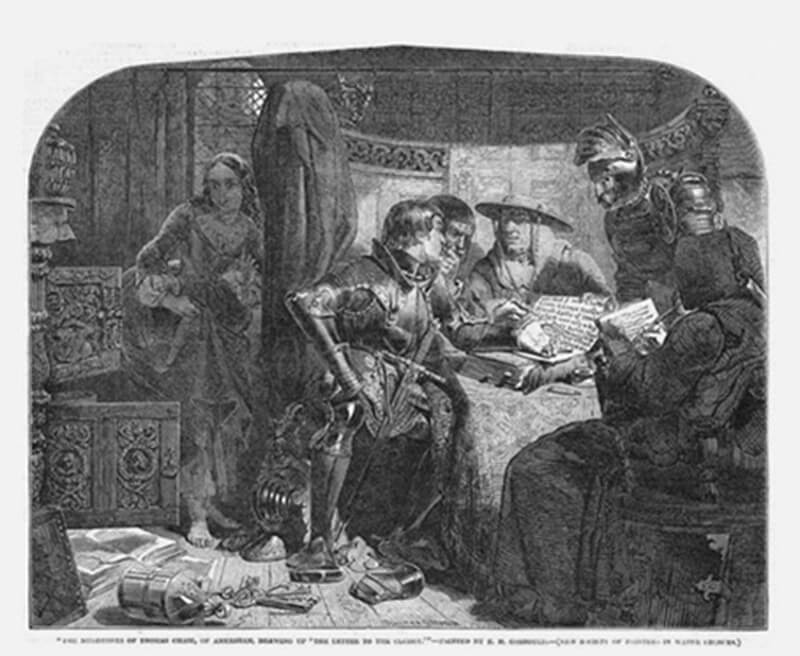
28 July 1849, the Illustrated London News published this dramatic print, “The Murderers of Thomas Chase, of Amersham, drawing up the Letter to the Clergy” by E H Corbould. As copies regularly appear for sale on online auction sites, I thought I should research the story.
Foxe’s Book of Martrys
The painting was inspired by the death of Thomas Chase as recorded in Foxe’s Book of Martyrs and was part of the Victorian evangelical revival. Most Victorian homes, churches and schools had a copy of Foxe’s book. It was first published in 1563 by John Foxe to document and celebrate Protestant Martyrs, particularly those persecuted during the reign of Queen Mary I and earlier periods of Catholic oppression. The book was considered essential Protestant reading, and inspired sermons, literature and art.
The Amersham Martyrs
The Amersham Martyrs were Lollards who were killed by Church authorities in the early 1500s. They were followers of John Wycliffe, who translated the Bible into English in the 1300s. Lollards denounced the wealth of the Church and did not believe that bread and wine changed into the body and blood of Christ at Communion. Their main demand was to read the Bible in English.
In the early 1500s, Bishop Smith of Lincoln started an enquiry into religious dissent in Amersham. As a result, the three principal leaders of the Amersham community died. William Tylsworth was burned at the stake in a field above the town. Robert Cosin, known as Father Robert of Great Missenden, was burned at the stake in Buckingham and Thomas Chase died in the bishop’s prison at Woburn. Ten years later, trials under Bishop Longland (following the death of Bishop Smith in 1514) ended in the burning of one woman and five men.
Thomas Chase
Foxe describes Thomas Chase as a poor man but “a man of godly, sober and honest behaviour”. It is likely that he was a labourer or small tenant farmer in Amersham. He was married (his wife visited him in prison) and literate as he read the Bible to his community.
When Bishop William Smith of Lincoln decided to stamp out heresy in Amersham, William Tylsworth was the first elder arrested. He refused to recant (declare in public that his previous beliefs were wrong) and was accordingly sentenced to be burned to death in 1511. Thomas Chase initially recanted and was forced to carry wood to Tylsworth’s execution. However around 1514, Chase was arrested again and taken to the episcopal manor at Woburn to be interrogated by Bishop Smith.
Here Chase was imprisoned in a cramped tiny cell known as a ‘little ease’. The cell was so small that he was unable to stand, lie down or sit comfortably. According to Foxe, he was bound with chains, kept hungry and cold, physically beaten and mocked by his guards. Foxe says that when torture failed to make Chase recant, he was “pressed” or strangled and died.
According to Foxe, the Bishop then falsely claimed that Chase had committed suicide and his body was buried secretly in an unmarked grave . “After that these stinging vipers (being of the wicked breed of Antichrist) had thus most cruelly and impiously murdered this faithful Christian, they were at their wits end, and could not tell what shift to make to cloak their shameful murder withall; at last to blinde the ignorant silly people, these butchers most slanderously caused it, by their ministers, to be heard abroad, that the aforesaid Thomas Chase had hanged himself in prison, which was a most shameful and abominable lie, for the prison was such that a man could not stand upright”. These were the dramatic words which inspired Corbould’s narrative painting.
E H Corbould
Edward Henry Corbould (1815-1905) exhibited the painting at the New Society of Painters in Watercolours in July 1849. A successful watercolourist, Corbould trained at the Royal Academy Schools and was most known for his illustrations of scenes from Shakespeare, Sir Walter Scott and British history. His works were widely exhibited and were popular for their detailed narrative style. His work reflects the Victorian era’s interest in moral virtue and national identity.
In 1842, Queen Victoria’s husband, Prince Albert, bought Corbould’s watercolour of The Woman taken in Adultery. Nine years later Corbould accepted the position of instructor of historical painting to the Royal Family, which he held for the next 21 years.
The painting
The scene depicted in the print shows Bishop Smith seated on an ornate wooden bench in a richly decorated room which is presumably in the manor at Woburn. He is surrounded by henchmen, including two hooded, darkly robed priests and two heavily armed soldiers in suits of armour. They are discussing the wording of the letter to be sent to the clergy covering their crime whilst a young servant girl listens to the conversation hidden from view.
The painting is rich in symbolism. The lamp tipped over bottom left signifies the attempt to extinguish spiritual truth, whilst the discarded keys represent the failure and moral corruption of the jailers. The open cupboards suggest that the truth will be told and the persecutor’s guilt will be exposed. The young girl listening symbolises innocence and hope for the future. She is a witness to the injustice. Despite persecution, Protestant ideas will spread among the young. Her attentive posture invites the viewer to listen and learn from the martyr’s example.
Commemoration
In 1931 the Protestant Alliance erected a memorial to the Amersham Martyrs in Ruccles Field and Chase is honoured with the following inscription:
“THOMAS CHASE, STRANGLED AT WOBURN BUCKS HIS BODY WAS BURIED AT NORLAND WOODS 1514”
This year the Tyndale Society (William Tyndale was another key figure of the Protestant Reformation who translated much of the Bible into English) are celebrating the 500 year Anniversary of Tyndale’s New Testament.