
By Alison Bailey, June 2026
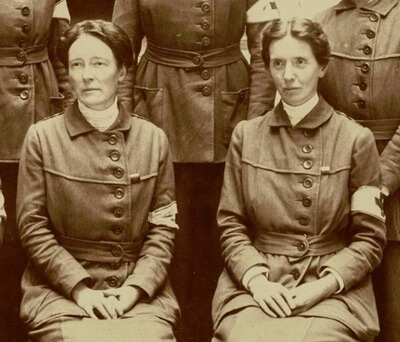
(Banner Picturw above – The staff of Endell Street Hospital in 1916. The RAMC male orderlies were gradually replaced by women as they were sent to the front.)
In commemoration of the start of the Battle of Somme on 1 July 1916, this week’s article tells the story of the remarkable women of the Women’s Hospital Corps (WHC) which was founded by two pioneering women doctors who lived at Penn. Louisa Garrett Anderson and Flora Murray founded the first British military hospital, Endell Street, which was run entirely by women. Being located close to the main London stations, the hospital started receiving the first casualties as early as 4 July.
As Wendy Moore explained in her book Endell Street, the trailblazing women who ran World War One’s most remarkable military hospital, “The Somme offensive brought the war into the heart of London as never before, it was impossible to conceal the scale of the bloodshed as unprecedented numbers of casualties began arriving in the capital”.
The Daily Sketch
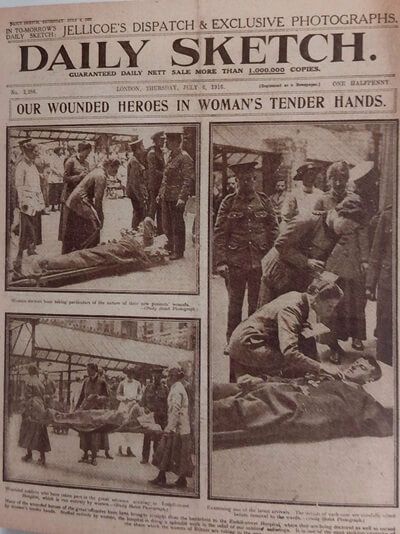
The front page of the Daily Sketch of 6 July 1916 carried the headline “Our wounded heroes in women’s tender hands”, with photos of soldiers on stretchers being reviewed by Flora Murray in the Endell Street courtyard. The journalist reminded its readers that the hospital had been viewed with great suspicion when it had opened the previous year and had been predicted not to last more than six months. Now over 16 months later, ‘the hospital was perhaps the most popular in London’. A popular tabloid with a circulation of one million, the Daily Sketch was just one of the newspapers which dived on Endell Street looking for a ‘good news story’ amongst all the horrors of the Somme.
Flora Murray encouraged this as a way of furthering the cause of women doctors and women in general. Soldiers who had survived the worst day in military British history now found themselves in the ‘Suffragette Hospital’, as Endell Street was often called, as both senior doctors and many of their staff were active members of the Votes for Women movement. Some, including Louisa Garrett Anderson, had been imprisoned for their militant activities. The soldiers were lucky, however, as the hospital really was one of the best. After the horrors of France, the colourful courtyard was a welcoming sight, lined with hanging baskets, window boxes and tubs of flowers.
Endell Street
Impressed by the WHC’s hospitals in Paris and Wimereux, Sr Alfred Keogh, the head of the Royal Army Medical Corp (RAMC) took the brave step of inviting them to run a hospital in London. The doctors had jumped at the chance and rushed over to inspect the former workhouse that they had been offered in Convent Garden. A disgruntled colonel showed them round who could not stop exclaiming “Good God Women!”
The new hospital was staffed almost entirely by women, from the chief surgeon, Louisa Garrett Anderson, to the orderlies. Flora Murray, the commanding officer, had a staff of 180 which included 33 doctors (although many were visiting consultants), 30 trained nurses including the formidable matron, Grace Hale and 80 orderlies. 17 wards, named alphabetically for female saints from St Anne to St Veronica, contained 520 beds (which increased to 573 at busiest times). The basement contained ‘The Johnnie Walker’ ward where drunken soldiers who had injured themselves on leave were left to sleep it off once their wounds had been dressed.
The wards were bright and cheerful with green painted walls. Every bed had reading lights and colourful blankets in red or blue. There was a large communal space on the ground floor with a library, billiards table and a stage for entertainments. Many celebrities and even royalty, particularly Queen Alexandra, visited the wards. But the most popular visitors included the doctors’ beloved terrier dogs, Garrett and William and a stray, Eepie. Mardie Hodgson, the transport officer and gate keeper had smuggled him back from France. Nevertheless, the special spirit of the hospital came from the unfailingly cheerful orderlies. These were mainly young girls recruited from well-off families, used to servants and more luxurious surroundings. The ‘WHC’ on the shoulder straps of their grey-brown uniform was interpreted by one wag as the ‘What-Ho-Corps’ and Endell Street soon gained another nickname as the ‘Flapper Hospital’.
According to Flora Murray’s memoir, Women as Army Surgeons: “they were unequipped and untrained; but had fine courage and did not resolution or intelligence, and with a little training, they took responsibility in the wards. Their very aspect was cheering, their gaiety was infectious and their willingness a thing that could be counted on”.
A few months before the start of the Somme the hospital had celebrated its first anniversary. 400 to 800 men were being treated each month and Louisa Garrett Anderson and her team had already performed around 1,500 operations. Then in June 1916, all hospitals were ordered to discharge convalescent patients as quickly as possible. Flora Murray sent many to the WHC’s auxiliary hospitals at Highgate, Dollis Hill and Crouch Hill where there were another 150 beds. All leave was cancelled for nurses and orderlies as the British bombardment pounded the front in preparation for the ‘great advance’
The Somme
The courtyard bell announced the arrival of ambulance convey after ambulance convoy and the senior doctors lead by example, working themselves to the bone. They operated in shifts of over 12 hours, with just a few minutes to grab food. Anderson had been asked to trial a new antiseptic paste by a doctor in Newcastle. On 8 July she tried BIPP (bismuth-iodoform-paraffin-paste) on the badly mangled foot of a young private for the first time. After the paste was applied the wound was stitched up and left for several days. Normal practice at the time was to clean and dress wounds every few hours, which was excruciating for the patient and time-consuming for the nurses. Amazing results were achieved with BIIP which transformed the workload for the staff and the outcomes for the men with many less amputations. Anderson published her results in The Lancet which was one of the first scientific research papers published by a woman doctor.
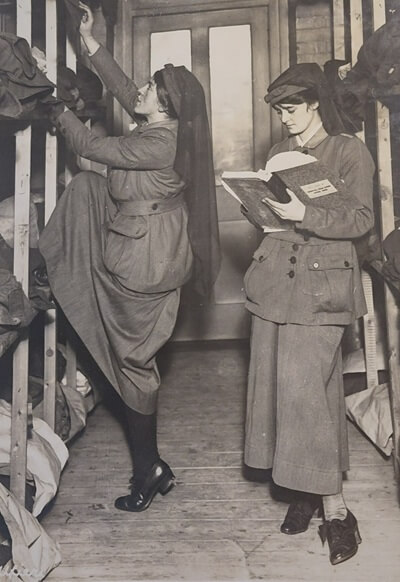
The daily drudgery, and the heaviest and most unpleasant tasks fell to the orderlies. In the linen room, Nina Last had to deal with more than 500 dirty sheets, infested with lice, and filthy with French mud. However, strong bonds were formed between the staff and the wounded men, many of whom were also suffering from the effects of shell shock. They spoke of the gulf between their reality of trench warfare and what they could say to their loved ones. The women who nursed the maimed and damaged men, heard their nightmares and listened to their stories of courage and failed nerve, came closest to bridging that gulf.
All photos courtesy of the Women’s Library, LSE
Sources
Endell Street, the trailblazing women who ran World War One’s most remarkable military hospital, Wendy Moore
Women as Army Surgeons, being the history of the Women’s Hospital Corps in Paris, Wimereux and Endell Street, September 1914 – October 1919, Flora Murray
Women’s Library, LSE