
Freight and the Amersham goods yard
by Alison Bailey
Today, we tend to associate railways with passenger transport but this was not always the case; it was freight, particularly coal that drove early railway development. In the early 1900s, as well as passenger services, the Metropolitan Railway was busy with the transport of goods, livestock and building materials (not to mention providing Chilterns farmers with the manure from London’s many horses!). Amersham’s extensive goods yard is now occupied by offices and the station multi-storey car park.
Coal
Britain’s industrialisation relied on coal power for mills and factories from the mid eighteenth century. Coal also heated our homes and businesses and from the early 1800s it was used to make gas for lighting and cooking. National coal consumption, rose from 20 million tonnes in 1820 to 160 million tonnes in 1900.
Transporting coal in bulk from the pits to the customer first prompted the growth of canals, establishing a transport network that linked with navigable rivers and sea. Nearly 4000 miles of canals monopolised the trade until the coming of the railways in 1825. Railways were much faster, more reliable and reached more destinations, ultimately about 20,000 miles. Once a town gained a railway, the cost of coal could halve.

Other Goods

Before the coming of the railway, transport was difficult and expensive, as until the twentieth century few roads were surfaced, and in winter many roads or tracks could be impassable for days. Livestock was driven on foot for miles along drovers’ paths from farm to market. Annual fairs, of which one is still celebrated in Amersham, were one of the few opportunities for people to buy more specialist items from travelling merchants.
When the railway arrived, life changed forever as even at small rural stations there were usually a couple of goods sidings. As a farming area, Amersham had pens for animals used for both receiving and sending to market. When local resident Doreen Benning left school in the 1920s, she went to work at Brazil’s. She started with her sister, and was given a white coat, wellingtons and a stick: “Up we walked to Amersham station and there was a carriage in the goods yard because there’s quite a big goods yard at Amersham station. They do a lot of shunting and changing about there, and we had to drive the pigs down the hill to the factory. Well, as we walked up, we’d shut all the gates, but the postman was going down the hill and he left some of them open. So we lost about four of them in the gardens, but that wasn’t too bad. We got the rest to the factory because there must have been about 40 pigs and people were walking up the hill to catch the train as well. It was quite hilarious really.”

General goods, much like today’s couriers, would carry parcels containing anything you could buy, from one of the new shopping catalogues or direct from the store. The distribution of the mail and newspapers also benefitted. Life became centred on the times of the often daily stopping goods train, dropping off a full wagon and picking up a new load to take away.
The quickest form of delivery was to send goods by passenger train. Goods could be placed on the train at Marylebone Station and the train met at Amersham and collected 40 minutes later, if urgently needed. When pharmacist A. H. Haddon took over his shop in Old Amersham in 1892, he obtained his supplies from an old firm of chemists’ suppliers and shop fitters named Sangers then operating from Euston Road in London.
Downside
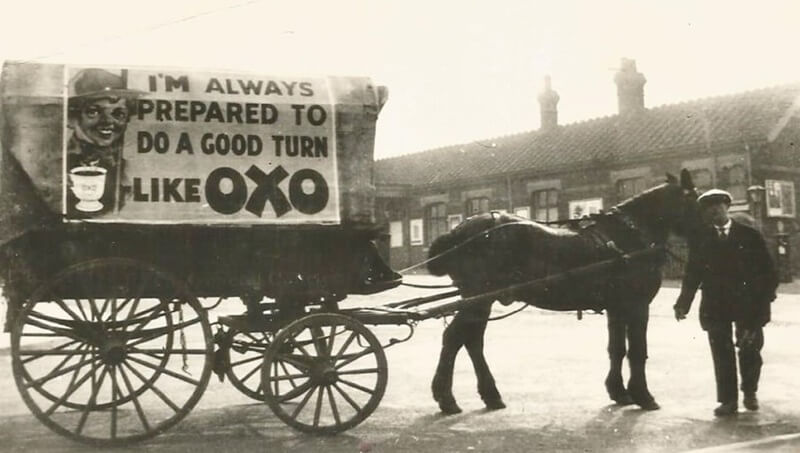
Whilst the benefits of rail were numerous, there were downsides. Small local artisans lost out to larger concerns that could now transport their goods to a wider audience. The influence of larger towns grew at the expense of their smaller neighbours. A significant casualty was the decline and eventual disappearance of the mail coaches. Amersham had several coaching inns providing stop overs, refreshments and stabling for horses. Fortunately three remain in use as licensed properties today. Although the mail coaches disappeared, it is widely stated that more horses were used after the railways were established than before, making the final delivery to the customer by road.
Peter Pontin was a carter from Chesham Bois who lived at Sunshine House (now part of Manor Farm Cottage) North Road. On 21 July 1936 the minutes of the Chesham Bois Parish Council Meeting record that “It was agreed that the Clerk should interview Mr. P. Pontin and formally request him not to tether his pony for grazing purposes in front of the War Memorial”!
Decline of Rail Freight
The railways dominated the movement of goods until the 1950s then gradually lost traffic to road haulage. A primary reason was that, following the Second World War, the railways were in a poor state of repair, unreliable and expensive to operate. At the same time, the government was selling off ex-War Department trucks and there was no shortage of drivers trained by the army leading to the emergence of new low-cost haulage operators able to undercut the railways and offer door to door services.
A benefit to the railways from a passenger point of view was that the many now abandoned goods yards were ideal to convert to car parks, as we see in Amersham, Chesham and Beaconsfield.
With thanks to Ralph Hilsdon for this extract from All Aboard to Amersham which is available from Amersham Museum for £8.50. It can also be purchased online in our shop.