
By Alison Bailey
In 1940 with the country under threat of bombing raids and even invasion, artists were commissioned to paint traditional British scenes. ‘Recording Britain’ was initiated by Sir Kenneth Clark, then Director of the National Gallery as a national scheme but local organisations were also encouraged to start their own collections.
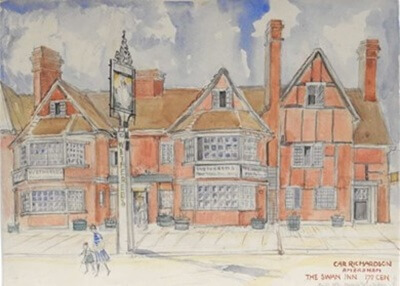
The Bucks Archaeological Society asked for members to record buildings of interest. In 1944, Amersham artist Car Richardson donated 38 watercolours of Buckinghamshire which are now in the Discover Bucks Museum Collection.
Recording Britain
Kenneth Clark was inspired by FDR’s American Federal Art Project during the Great Depression which employed artists to create over 200,000 pieces of art, as a way of providing employment and boosting morale and the arts. Clarke’s scheme, from 1940-43, was funded by the Pilgrim Trust. It was initially called ‘Recording the changing face of Britain’ before its more memorable title was used and it employed more than 90 artists to create ‘sympathetic records’ of threatened landscapes and buildings.
A project committee, which included the National Trust, the Council for Preservation of Rural England and the Society for the Preservation of Ancient Buildings decided on the subjects to be represented such as neglected parish churches and redundant industrial buildings. Rural scenes, already threatened by change were the most popular subjects as these were seen to symbolise the core values of Britain’s national identity.
The committee favoured traditional art, so watercolour was chosen, and post 1918 buildings were excluded. Photographic records were also commissioned for a separate project, The National Buildings Record, also established in 1940 and funded by the Pilgrim Trust. In total 1,549 watercolours and drawings were produced for Recording Britain and the most famous artists employed were John Piper and William Russell Flint. From 1943 the art was exhibited in the nearly empty National Gallery (its paintings having been safely evacuated to Wales) and around the country to ‘stir patriotic sentiment’ and boost morale. Today it is part of the V&A Museums Collection.
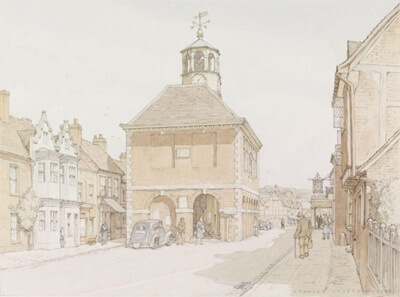
Stanley Anderson produced many of the Buckinghamshire watercolours in the collection. Anderson, who lived near Thame, submitted paintings of Amersham, Beaconsfield, Jordans, Wendover and Princes Risborough.
Recording Bucks and Dr Clive Rouse
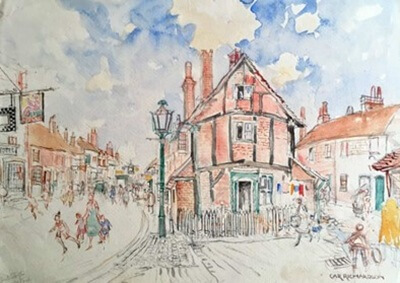
In 1941 the local press reported that the Bucks Archaeological Society (BAS), who had founded the Bucks County Museum in 1907, had been asked by the National Buildings Record to take photographic records of the churches and secular buildings in the county, in case of possible destruction due to the war. Three years later it was reported that acting in co-operation with the Central Council for the Care of Churches an almost complete record of the County’s churches had been made. It was also reported that Miss Car Richardson had presented the Society with some admirable watercolour drawings.
The project was led by Clive Rouse, then secretary and later president of BAS, a writer, archaeologist and historian from Gerrards Cross. A graduate of St Martin’s School of Art in London and a fellow in the Society of Antiquities, Rouse was an Internationally recognised authority on Medieval wall paintings and heraldry. In 1935 he published a Guide to Buckinghamshire. He also worked to research and recover the wall paintings discovered in Amersham High Street, now known as The Worthies and at St John’s Church, Little Missenden. In 1938 Rouse uncovered the Penn Doom painting at Holy Trinity Church after some decaying boards were discovered above the chancel arch and were discarded in the churchyard.
During WWII, Rouse’s eye for detail was put to good use when he joined the RAF Central Interpretation Unit at Medmenham, interpreting serial photographs to map enemy movements. He was awarded an MBE for his service. After his death in 1997 his collection of armorial porcelain was auctioned by Sotheby’s for £72,000. The most important pieces had already been donated to the Ashmolean Museum in Oxford.
Car Richardson
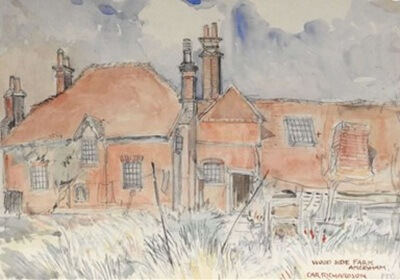
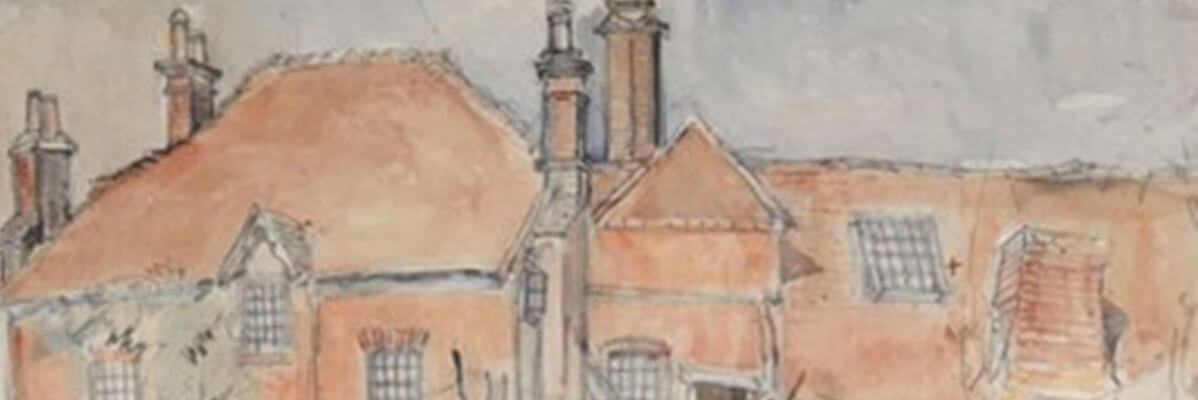
Caroline “Car” Richardson taught art in London before retiring to live in Amersham. She lived in the Tithe Barn, Bois Lane Chesham Bois from 1915 until her death in 1959. During her life she produced 100s of portraits and landscapes including European scenes from her extensive travels. However, she was passionate about recording local buildings such as old farmhouses and timber-framed barns. She was concerned that they could soon be lost and sometimes recorded a note such as “soon to be pulled down for a new road”. She also painted over 100 windmills in the east and south of England.

A reviewer of an exhibition of watercolours of English country scenes at the at the New Dudley Galleries in Piccadilly time said that “Miss Richardson is an artist that excels in simple scenes. A turn of a road, an old inn, a clump of trees or a cluster of cottages are most realistically produced on her canvas; she understands the stray nooks and corners of the country”. Car was able to portray the structure of old buildings and convey their character in a way which could not be achieved in a photograph.
During both World Wars, Car served with the Red Cross as a VAD. In WWII she worked as an occupational art therapist at the Emergency Service Hospital in Amersham and at RAF Halton.
Progress
In the event the damage from bombs and invasion proved to be less devastating to the subjects of Recording Britain than did the needs of a growing population and the expansion of the transport network. Today Car Richardson’s lovely watercolours and the V&A Collection remind us of some of the buildings already lost and what is under threat again by uncontrolled development and sprawling urbanisation.