

Jennifer Worth (1935-2011) and Christine Lee (b 1938) – The Midwife in Amersham
By Alison Bailey February 2026
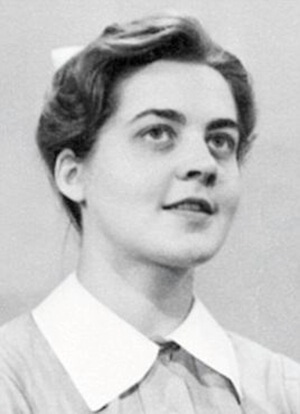
Jennifer Worth who wrote three best-selling memoirs: Call the Midwife, Shadows of the Workhouse and Farewell to the East End, grew up in Amersham. Currently in its 15th series, the popular BBC drama Call the Midwife focuses on a group of nurses working in the East End. Created by Heidi Thomas, the series was originally based on Jennifer’s experience of working in this poverty-stricken community during the 1950s.
Jennifer’s younger sister, Christine Lee, a renowned sculptor, published a memoir about their childhood, The Midwife’s sister, in 2015, four years after Jennifer’s death. The sisters’ early childhood in rural Amersham was idyllic but this all changed in 1945 when their mother suffered a catastrophic stroke when she discovered her husband in bed with his secretary and the marriage disintegrated.
The Lees

Gordon and Elsie Lee met at a dance in 1933. Some years earlier, 14-year-old Gordon had hitched a lift from his home in Wales and had been dropped off on the outskirts of Amersham. He asked for work at the garage there, and having driven tractors from a young age, was given a job delivering tyres. Quick to learn, Gordon saved enough money to buy a milk float and established his own business. He persuaded his widowed mother and older brother Clarence to join him in Amersham and the family moved to Quarrendon Farm.
Born in 1914 in Amersham, Elsie was Eliza and Arthur Gibbs youngest child. Although spoilt and petted by all the family, she was bright and won a place at Dr Challoner’s School. After a two-year training programme, she became a clerk in the Post Office.
Christine described her mother as: “an extremely pretty, dark-haired girl with an hour-glass figure and great legs. She wore the latest fashions, danced a mean charleston and was greatly admired by all”. When Gordon offered to take her home after the dance, she was undeterred by the milk float.
The couple were married at Amersham Free Church by Reverand Waugh in 1935 when Elsie was already expecting a baby. To avoid any scandal Eliza took Elsie to Clacton and Jennifer was born there in September 1935. The couple lived in one of Eliza’s houses above a shop in Hill Avenue and Eliza bought her new son-in-law a lorry and helped him launch his haulage business, Lee Transport.

Eliza Gibbs
Eliza Gibbs was tiny but formidable. She was a successful businesswoman with a tobacconists and confectionery kiosk just outside Amersham Station. She was also an early property developer in in the new town.
Born Eliza Webb in Steeple Claydon in 1875, the daughter of an agricultural labourer, she went into service before marrying soldier Arthur Gibbs in 1902. Arthur was originally from Hampshire, the son of a painter and decorator. A veteran of three wars, he served with the Scots Guard in the Boer War and WWI and was a member of the Home Guard during WWII. The couple moved to Amersham around 1905 with two young daughters and went on to have five more children. Arthur worked as a postman but was unable to work for a time after his traumatic experiences in WWI and Eliza took over. Always careful with her money, she had saved enough to buy two cottages in Steeple Claydon which she sold for a profit and invested in shops and houses in Station Road and Hill Avenue. She kept her financial dealings secret from her family, and they were all astonished when she died and left each child their own property.
An idyllic childhood

Christine was born some two years after Jennifer in February 1938. Gordon’s business was expanding rapidly after he won a government contract to transport essential equipment to Scotland which meant that he was exempt from active service. He bought a house in Clacton at Jaywick Sands that all the family went to during the summer. Despite rationing, there was always plenty to eat. Gordon received extra food from a farmer friend, Eliza kept chickens and Arthur had an allotment. The girls weren’t even affected by the strict sugar ration as their grandmother owned the sweet shop!
During the war Elsie drove nurses to Shardeloes from Amersham and the girls would go with her and collect armfuls of cowslips in the surrounding fields. A Jewish couple who had escaped from France moved into the downstairs kitchen, after Elsie found them exhausted in a shop doorway. A young couple with their baby became lodgers on the top floor and had to use the house’s only bathroom as their kitchen putting a door across the bath to create some workspace. Christine remembered that the room always smelt unpleasantly of food when they took their weekly bath and they had to sit in the airing cupboard for at least an hour to dry their hair.
The girls started at Kingsley House School on Woodside Road which they walked to alone hand in hand. They then travelled on the steam train to Belle Vue School for Girls in Little Chalfont, later Hyde House at Hyde End. Every week there were ballet lessons at the Fabian School of Dancing and piano lessons by Miss Goudie at White Lion Road.
The sisters enjoyed incredible freedom roaming the countryside with Jennifer’s beloved Lakeland terrier, Bryn. They would climb the stile at the railway crossing to put pennies on the rails and wait hidden in the grass next to the line: “Trains would pass at speed, unaware of two small girls hiding in the grass. The noise of the wheels on the line was huge, and the wind even more so, throwing us sideways as the carriages roared past. Then we would run excitedly onto the line to inspect our pennies, and compare their size and shape – such fun, they were hot and misshapen”.
Disaster
When the marriage ended in 1945, Gordon and Elisa both made disastrous second marriages which left the girls neglected and unwelcome in either house. After a row with Elsie’s new husband, Jennifer, age 14, was forced to leave and find lodgings in Plantation Road. After taking a shorthand typing course in London, she got a job as the secretary to the headmaster of Dr Challoner’s School after she told him that she was 17 rather than 15. Jennifer fell hopelessly in love with Nevill Harrow who was in his late 50s and married but took a genuine interest in the plight of the two girls. With his encouragement Jennifer and later Christine both applied to train as nurses at the Royal Berkshire Hospital in Reading. Nursing would provide the sisters with a home (all trainee nurses were then given accommodation) and the intellectual and emotional stimulus they needed. The rest, as you might say, is history!

Sources
The Midwive’s Sister, Christine Lee, 2015
Call the Midwife, Jennifer Worth, 2002
Jennifer Worth obituary | Autobiography and memoir | The Guardian
Call the Midwife: Touching true story of the women behind hit BBC series – My London
The moving story behind Call The Midwife – brought to life for the screen as the original author Jennifer Worth¿s health began to fail – is told in a touching new book by the show’s writer | Daily Mail OnlineThe Real-Life Inspiration Behind Call the Midwife,
Wikipedia
British Newspaper Archive
Ancestry