
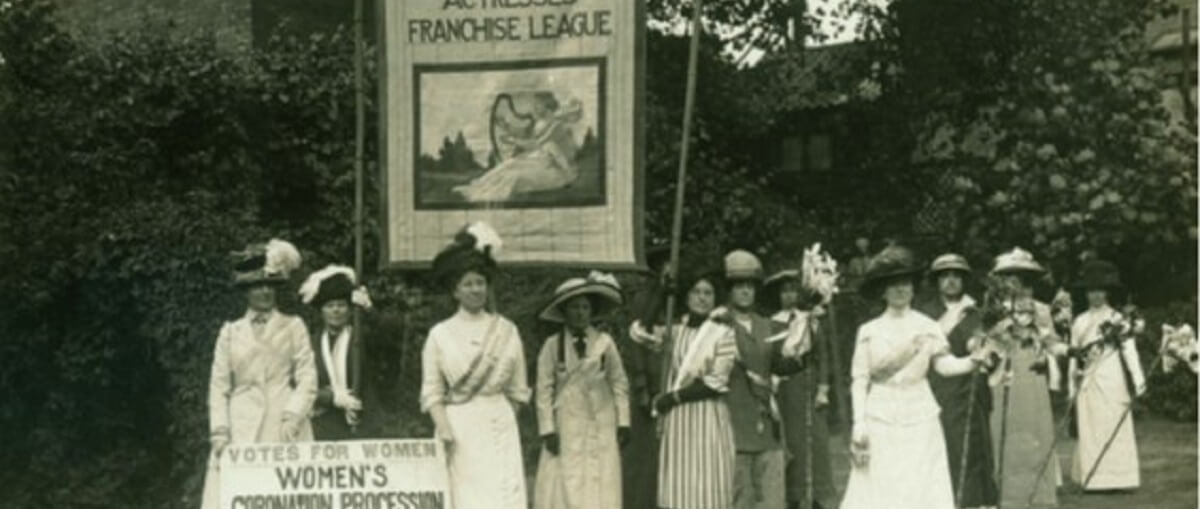
Louise Jopling’s banner for Actresses’ Franchise League, 1911, courtesy of the Women’s Library @LSE
By Inaya, one of our young curators
Also refer to the article by Alison Bailey
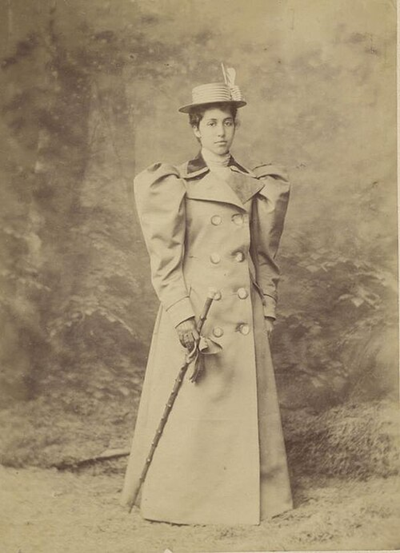
As the founder of the Women’s Social and Political Union, Emmeline Pankhurst’s larger-than-life presence dominates the history of the women’s suffrage movement. However, to me, there is another woman who perfectly encapsulates the spirit of the fight for female enfranchisement. The daughter of a deposed Maharajah, Sophia Duleep Singh was born a privileged but powerless princess. Through her father’s lavish spending and her status as Queen Victoria’s much-beloved goddaughter, she enjoyed a comfortable life – nobody would have blamed her for ignoring the fight for gender equality. Instead, she dedicated many years of her life to the cause.
Socialite to Suffragette
During Sophia’s youth, gender inequality had little tangible impact on her life. However, following her sister’s expulsion from university due to her gender, the princess found herself drawn to the WSPU’s growing calls for “Votes for Women”. So, when Sophia’s fellow socialite, Una Dugdale, encouraged her to join Pankhurst’s organisation in 1908, she agreed. The princess enthusiastically participated in marches against Parliament, smashed windows and even threw herself against the windows of the Prime Minister’s car, brandishing a “Votes for Women” banner. Her fame made her a valuable weapon in Pankhurst’s arsenal, since her actions often attracted more attention from the press than those of her fellow suffragettes.
However, this fame also restricted the princess in an area where many other suffragettes excelled: imprisonment to attract attention. During her tenure as a women’s right activist, the authorities never imprisoned Sophia. They believed – correctly – that arresting a suffragette of such status could potentially lead to public outcry and would certainly encourage more young women to join the movement. The government evidently realised how much influence Princess Sophia Duleep Singh held, and they knew they had to tread carefully. Sending the princess to prison would only draw even more attention to the already infamous WSPU, and the government couldn’t afford for Sophia to be used as a political martyr, despite her own willingness.
Victorian Values
Though Queen Victoria died in 1901, seven years before Princess Sophia joined the Women’s Social and Political Union, she was blatantly clear during her lifetime that she opposed the women’s suffrage movement and everything it stood for, instead favouring the preservation of traditional gender roles. However, despite how much her godmother had done for her and their mutual love for each other, Sophia refused to let herself be held back by the late Queen’s views. She recognised that society needed to move forward, and that meaningful change can only be enacted by disrupting the existing order.
A Feminist Legacy
So, by the time Princess Sophia Duleep Singh died in Penn in August 1948, she had much to be proud of. She’d been a core member of Pankhurst’s WSPU – the organisation that, despite its dangerous and criminal tactics, achieved the most in the fight for female enfranchisement. Besides this, Sophia had also served as a nurse during the World War One, sheltered three children at her Buckinghamshire home in World War Two and expressed deep support for Indian independence. The princess spent her life putting aside her own comfort to help others and for the sake of the greater good, epitomising the kind of spirit which deserves to be celebrated and commemorated when remembering the women’s suffrage movement.