
Amersham’s long ties with the town twinning movement and the Amersfoort stone
By Alison Bailey
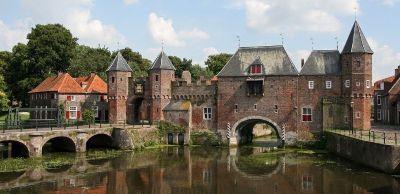
Amersham has been twinned with Bensheim in West Germany for nearly 50 years but the council’s involvement in town twinning goes back even earlier to 1958 when a connection was established with the Dutch City of Amersfoort, 26 miles south-east of Amsterdam.
The history of town twinning
The international town twinning movement promotes cultural and commercial links between communities, often linking places of similar size, or with a shared history or connection. Twinning is a voluntary arrangement between local authorities, usually initiated by personal involvement.
The earliest known twinning is between a town in Yorkshire and a small rural community in northern France, established at the end of WWI. A soldier from Keighley who had witnessed the devastation of the area persuaded his town to raise funds for a community hall in Poix-du-Nord which was then named Keighley Hall.
After WWII, town twinning spread rapidly across Europe as a tool for reconciliation and reconstruction. Coventry twinned with Stalingrad (now Volgograd) and later with Dresden, all three having been heavily bombed during the war. There are also more light-hearted connections; in 2012, Dull in Scotland joined forces with Boring in Oregon, USA and later Bland in Australia, together forming the ‘Trinity of Tedium’!
The Association of Amersfoort and Amersham
Amersham’s first town twinning arrangement was a grassroots initiative. It was started by Reginald James Woolacott, a director of a contracting and building business, after a visit to Holland in 1957. Reg Woolacott lived with his wife Betty and children at Holmside, Amersham Common. Whilst travelling in the Utrecht province he saw a sign to Amersfoort and struck by the similarity between the names, decided to visit. He liked what he saw and persuaded Amersham Parish Council to approach the Burgermeister (mayor) of Amersfoort, with “a view to foster mutual friendship between the two townships”. The connection was made and in 1958, 22 teenagers and 3 adults visited from Amersfoort to stay with Amersham families.
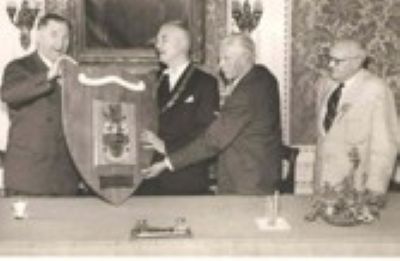
The following year 36 adults from Amersham visited Amersfoort to celebrate its 700-year anniversary. An English oak shield with the Coat of Arms of Amersham was presented to the Burgermeister. The party returned with a flag, specially created to mark the occasion, to fly in the Memorial Gardens.
Visits were made in both directions throughout the 1960s. The Amersfoort Accordion Club visited Amersham and Raans County Secondary School’s brass band gave a concert in Amersfoort. In 1970, 1971 and 1972, the Amersfoort Cricket and Hockey Club and the Amersham Fencibles Cricket Club (formed in WWII by the Home Guard) exchanged tours. In 1972, the Amersfoort City Trumpeters took part in the Amersham Carnival.
The Amersfoort Stone
Over the years different presents were exchanged. Amersham gave some beech trees to Amersfoort and in turn, they presented bulbs for the Memorial Gardens. In 1971 Reg arranged for a most unusual gift, inspired by the history of Amersfoort. Through his many visits Reg had learnt that the city was known as Keistad, which translates as Rocktown or Bouldercity. The nickname originated in the 1600s when the local squire made a bet with 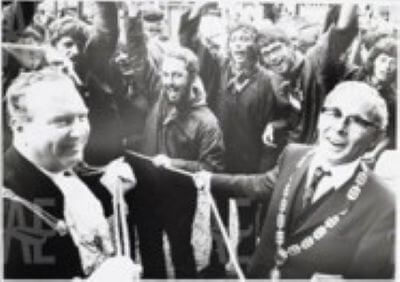
The stone being unveiled by Amersfoort’s Mayor Troostwijk (on the right) with Sir James Miller, the former Lord Mayor of London and Lord Provost of Edinburghsome friends that he could talk the people of Amersfoort into
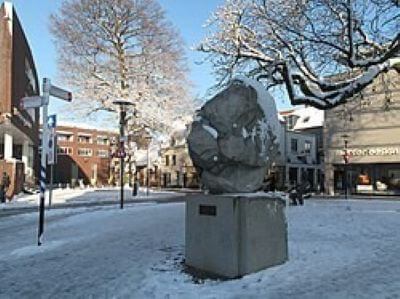
dragging a large stone to the city centre. The boulder had been deposited on a nearby moor by a glacier and weighed 9 tons. 400
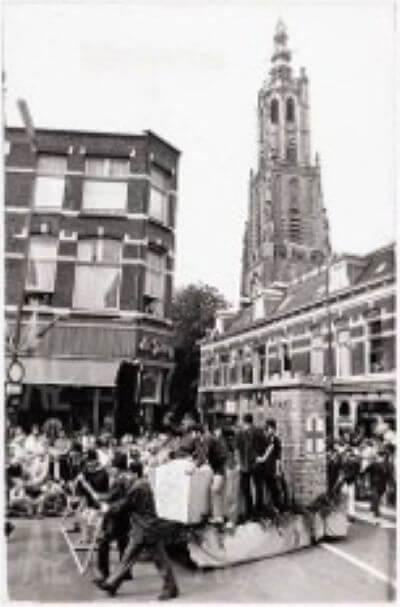
Amersfoorters signed up to the task and pulled the stone into the city over cannon balls. The squire won his wager and grandly spent the 3000 guilders on beer and pretzels for a party. After their neighbours started to make fun of this event, the Amersfoorters buried the boulder, hoping the other cities would forget about it. In 1903 the boulder was rediscovered and it became a well-known local monument.
In 1968, John Rennie’s 1831 London Bridge was sold to the USA. The bridge was taken apart, and most pieces was meticulously numbered and sent to Arizona. However, some were kept and placed with earlier stones from the Medieval bridge near the 12th century church of St Magnus the Martyr.
At that time, Reg was a director of Percy Bilton Ltd, a construction company in Slough, and was the president of the National Federation of Building Trades Employers. Papers in Amersham Museum’s collection show that Reg persuaded John Mowlem, the company which had constructed the new London Bridge, to let him have a four-ton granite stone, which had been part of the balustrade of the Victorian bridge. He had this shipped to Amersfoort accompanied by his friend, Sir James Miller, the former Lord Mayor of London and Lord Provost of Edinburgh. The stone was processed through the streets before being unveiled by Burgermeister Troostwijk.
A plaque on the side of the stone reads:
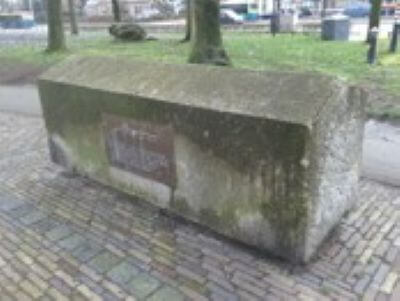
This granite formed part of Old London Bridge, London, England and was presented to this city of Amersfoort by the Association of Amersham and Amersfoort and placed here on August 21, 1971, as a permanent reminder to the citizens of Amersfoort of the esteem held for them by the people of their link town Amersham, Buckinghamshire, England.
During the 1970s a new town twinning association was suggested between Bensheim and Amersham following regular football tours between the two towns. Reg expressed his disappointment in a letter to the local paper asking, “what has Bensheim got that Amersfoort lacks?” However interest in the Dutch city seems to have dwindled, the new arrangement was established, and the Association of Amersham and Amersfoort was finally disbanded in 1979.