
By Alison Bailey

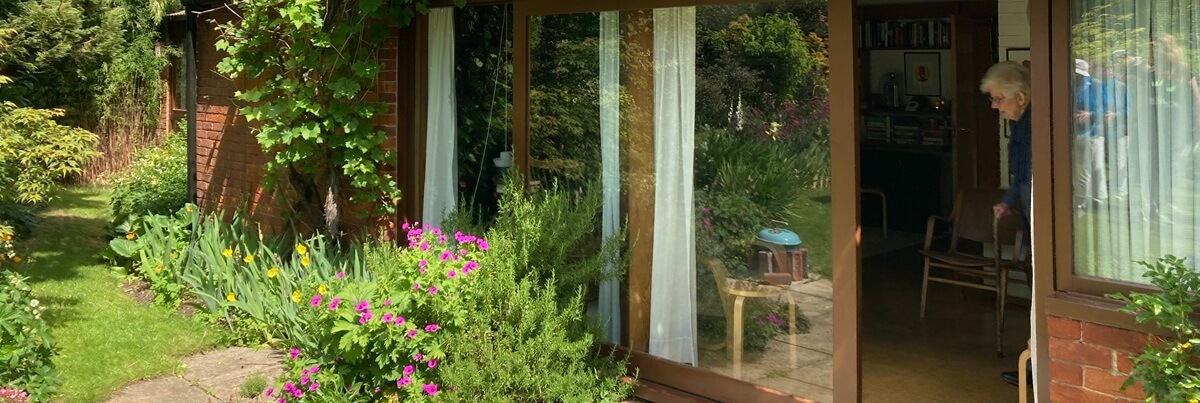
Monica and William Mullins (1926-2020) moved into Vine House, Cherry Lane, Old Amersham in 1961. The house had just been completed to their own design and was surrounded by a large, partially walled plot, where the Mullins planned to create a garden. The house was named after the vine they planted there that first year.
A small ad
Two years earlier, newlywed and living in a small flat in Dulwich, Monica spotted a small ad in the Observer newspaper advertising a plot of land for sale in Buckinghamshire. The land was part of the extensive garden of Piers Place, and the owners had already completed Red House, a contemporary house designed by Ernö Goldfinger on the site. John Wallis, the owner, had a vision of two Modern Movement houses carefully sited within part of the walled garden.

Monica and Bill had met at the London practice of Richard Sheppard & Partners (later Sheppard Robson) where they both worked. It was their mutual interest in contemporary architecture that convinced Wallis that here was the right couple to design and build their own house on the plot.
Monica had trained at the Leicester School of Architecture and worked at Richard Sheppard & Partners for seven years mainly designing school buildings. Bill worked his way up Richard Sheppard’s practice after joining as an architectural assistant at the age of 21 in 1947. He had left full time education at Leyton County High School five years earlier to start work. In the evenings he studied architecture at Regents Street Polytechnic before winning a scholarship to the Architectural Association School in 1945. After joining Richard Sheppard, his early experience was in designing schools and colleges. In 1955, he designed Weeks Hall, and Southside Halls of Residence for Imperial College London. Built in innovative precast concrete and glass, these were subsequently Grade II Listed.
Churchill College
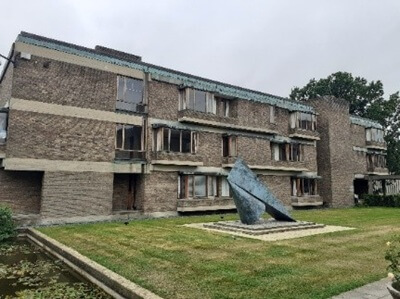
In 1959, Bill was responsible for the practice’s winning submission for a competition to design a new college for Cambridge University. This was whilst he was planning the house in Cherry Lane, so it is no surprise that Vine House shares many materials and design details with Churchill College. The college became a full-time commitment for the next five years and on completion, was Grade II Listed.
In 1960 Bill was appointed a partner of Shephard Robson, and 10 years later, a Fellow of the Royal Institute of British Architects (FRIBA). In 1974, he designed the conversion of an old piano works for Sheppard Robson’s new offices when they moved to Camden Town. The offices received Civic Trust and Office of the Year awards. As the practice expanded, Bill designed shopping centres, offices and housing and acted as consultant for a variety of projects overseas.
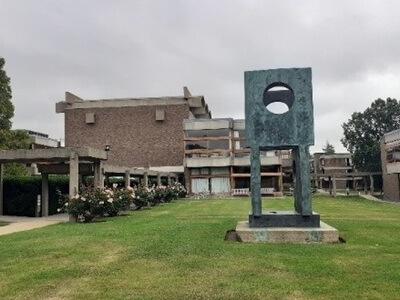
Bill published books on architecture, including in 1971, Student Housing: Architectural and Social Aspects with Phyllis Allen. He was a visiting lecturer at Washington University in St Louis. From 1988 he associated with Robert Venturi, the architect for the Sainsbury Wing of the National Gallery, before retiring in 1991. In 2017 Churchill College recognized Bill’s contribution by making him an Honorary Fellow of the college. After his retirement Bill was able to devote more time to sketching and the walls of Vine House are covered with his colourful, detailed paintings.
Amersham Museum
Bill and Monica moved to Old Amersham just after the founding of the Amersham Society, following the successful campaign to protect Shardeloes House from demolition in 1956. Their architectural knowledge and experience were invaluable to this heritage society and their new community, and they were instrumental in the establishment of the Old Amersham Conservation Area.
In 1984 Monica was appointed Honorary Curator to the fledgling Amersham Museum which operated out of one room at the British Legion in Whielden Street. 49 High Street had been purchased earlier that year but needed extensive restoration before it opened 23 March 1991. Working from home, Monica catalogued and sorted the collection of documents and artefacts. She set about designing the showcases and exhibits for the new museum and her efforts were rewarded when the museum was awarded the Shoestring Award at the National Heritage Museum of the Year Awards for “the museum managing to do the most with the least”.
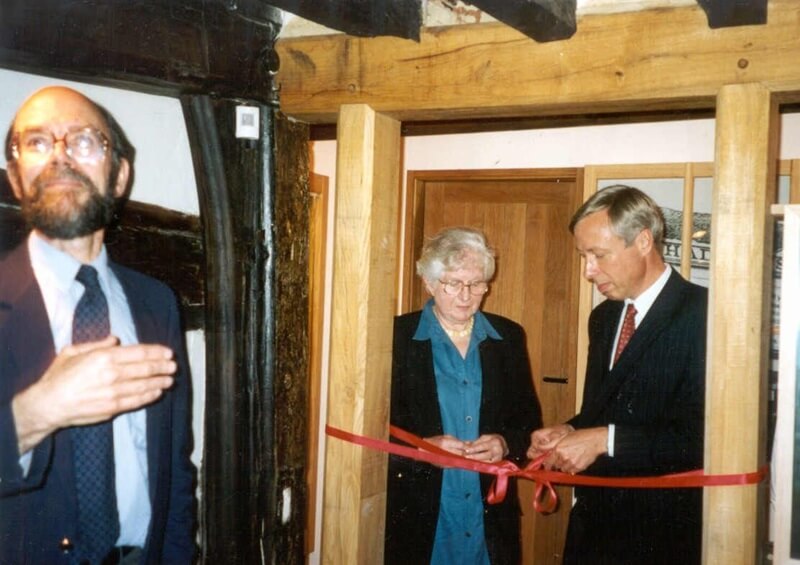
In 2000, Bill designed a small extension to 49 High Street and, after working from home for 16 years. Monica was finally able to bring all her files and the last of the collection across to the museum. With the additional space, Monica was able to develop further displays, and created a new exhibit concerning the shocking story of the burning of the Amersham Martyrs. This inspired the first Amersham Martyrs Community Play the following year. In 2003 Monica decided to retire and a garden party was held in the museum to thank Monica for dedicating 20 years of her life to establishing the museum and to Bill for all his support.
Monica and Bill’s eldest son, Matt is an artist and printmaker working with photopolymer etching and screen printing. In 1994, David established Mullin Kites in the Maltings, manufacturing and selling a range of kites, from children’s to high-performance parafoil kites.
Sources
Monica Mullins
50 Years of the Amersham Society by Dr Michael Brooks, Christine Standring and Barbara Webber and published in 2006 to mark the 50th Anniversary of the Amersham Society.
Corbusier Comes to Cambridge: Post-War Architecture and the Competition to Build Churchill College by Mark Goldie
William Mullins Obituary – Churchill College (cam.ac.uk)
Ancestry.com
British Newspaper Archive