
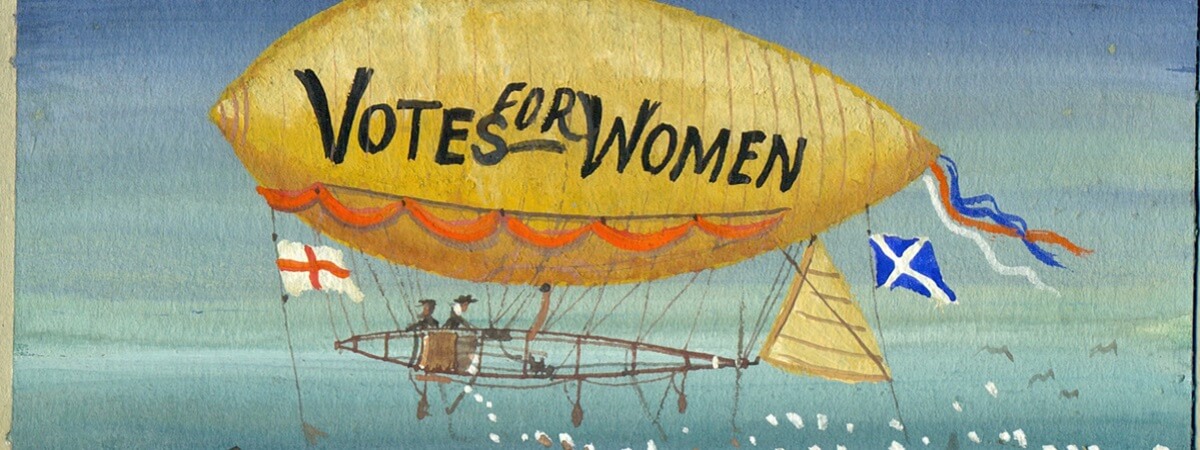
When the Amersham Museum acquired a copy of the Women’s Suffrage Cookery Book, among the many contributions, two recipes and a knitting pattern were from a local suffragist Miss Julia Sharpe who lived in Great Missenden. Using a combination of census, electoral roll, university alumni records, genealogy records and newspaper reports, it was possible to discover Julia’s life story and her links to the suffragist movement. Julia Sharpe was born on 25 Jan 1853, at 1, Highbury Terrace, Islington into a busy household, the seventh of eight children. Her father was William Sharpe, an attorney and solicitor, and her mother Lucy Reid, the daughter of a wealthy merchant. The large family house was also home to three servants; a cook and two maids. The family was made up of six girls and two boys. William died in 1870, leaving around £30,000 in his will and in 1871, eighteen year old Julia was still living in Highbury Terrace with one of her brothers and four of her sisters. Between 1871 and 1881, several of her siblings married and moved away, but Julia’s life took a very different direction.
Julia showed an early interest in education and in the mid-1870s was the Honorary Secretary for the North London Ladies’ Educational Association, organising talks and lectures.[1] In 1878, just three years after Newnham College had opened its doors as the second women’s only college at Cambridge University, Julia enrolled on the equivalent of a degree course.[2] Cambridge didn’t award degrees to women until 1948, some thirty years after they gained the vote despite Oxford University awarding degrees from 1920 and the University of London as early as 1880. Julia spent three years at Newnham College and after ‘graduating’, from 1881 to 1886 she worked as a teacher of botany. In the 1881 census, Julia and her sister Letitia were living with their mother and she gave her correspondence address for various societies as 1 Highbury Terrace, so it seems likely that she was working in a London school.
Julia maintained her close contacts with Newnham College and from 1881 to 1886 she was the Honorary Secretary of the Newnham College Club. It was most probably through this connection that Julia met Caroline Herford, beginning a friendship that would last for over fifty years. Caroline was seven years Julia’s junior and attended Newnham College from 1885 to 1886.[3] Caroline was from a similar background to Julia, having been raised in a large family who valued education for women. In 1886 when Caroline ‘graduated’, she moved back to Manchester to become the Headmistress of Lady Barn House School, a co-educational school which had been started by her father William in 1873 with just nine pupils. By 1886 the school was thriving and not only did Caroline move to Manchester but Julia and another Newnham graduate, Edith Pantin, joined her as Assistant Headmistresses. Edith stayed at the school until 1898, and in 1891, all three were living at 17 Mauldeth Road in South Manchester where the school had started. In 1901, Caroline and Julia continued to live in Mauldeth Road with various boarders and Caroline’s nephew and niece, both pupils at the school. Caroline and Julia’s names appeared linked together frequently in newspapers, whether making donations to the NUWSS or presenting cups at women’s sports and gymnastics clubs.
In 1907, after twenty one years at the Lady Barn House School, Caroline left to look after her aging father and Julia left at the same time. A glowing tribute to Caroline appeared in the Manchester Courier on the 29th December recognising that ‘she was one of the dreamers and visionaries, and at the same time she had the most practical wonderful sagacity’.[4] It was also noted that ‘it was also the desire of the subscribers to make some little personal presents to Miss Herford and Miss Sharpe, who also was leaving, and who had rendered great and unique service to the school’. And so began the next short chapter in their lives, in Great Missenden around 1909.
The Suffrage Cookery Book identified a Julia Sharpe living in Great Missenden, but was this conclusively the same Julia Sharpe from Manchester? Caroline’s alumna record from Cambridge showed that she was working as the first Lecturer in Secondary Education, and Julia’s showed that she was an art student at Reading University between 1909 and 1910 which placed them as working in Berkshire.[5] One final piece of information finally confirmed that Julia and Caroline were living in Great Missenden. Although women were unable to vote in Parliamentary Elections, they were able to register to vote in local elections if they were single or widowed and a rate payer. And there in the records for Great Missenden was Caroline Herford living in Grimms Hill between 1909 and 1911, although the specific house wasn’t mentioned.[6] When the census was taken in early April 1911, Julia and Caroline were lodging at Porthcothan Mill, St Merryn in Padstow, seemingly on holiday. Julia described herself as a ‘Retired Teacher with Private Means’.
Whether they missed Manchester or a more interesting opportunity arose for Caroline, their initial time in Great Missenden was quite short and on leaving in 1911, they would not return to live in Great Missenden for over twenty years. The friends moved to Stanswood, a substantial Arts and Craft house in Oak Drive, Fallowfield in an affluent suburb of South Manchester. Caroline continued to pursue her career as a Lecturer at Manchester University, becoming a JP and a local councillor and was awarded an MBE for her work as a Red Cross Commandant, organising university students to meet ambulance trains in the First World War.[7]
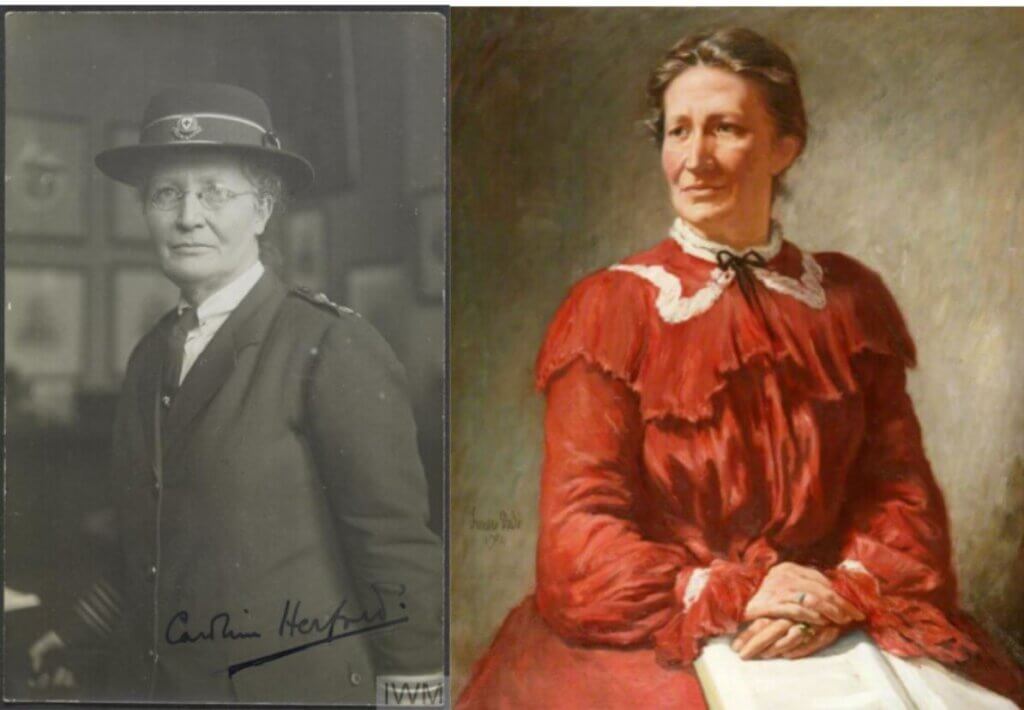
Photograph of Caroline in 1919 courtesy of the Imperial War Museum[8] and
Painting of Caroline by Francis Dodd in 1904 courtesy of Manchester Art Gallery[9]
Julia’s interest lay in different direction concentrating on organisations concerned with childcare. From the Manchester School for Mothers which had been set up to reduce infant mortality of as part of a national movement, supporting Day Nurseries for working mothers, through to the Princess Christian College for training Nursery Nurses, providing nannies to wealthy families, Julia frequently served as committee member and Chairman for these organisations.
In 1924, after living together for thirty eight years, Caroline’s life took an unusual turn. After the death of her elder sister Dorothea Blake in 1923, Caroline now aged sixty four moved to Somerset and married her widower brother in law, Robert Blake. Meanwhile Julia moved back to London living at Meadway in Hampstead Garden Suburb less than a mile from her two unmarried sisters, Mary Catherine and Letitia.[10] Julia wasn’t the only suffragist in her family. Mary and Letitia’s house in Highgate had frequently been opened to members of the NUWSS for fund raising events and they too made many donations to the NUWSS. Julia was now seventy and the fashionable Arts and Craft style house was possibly intended to be a final move.
There was still plenty of work to be done to achieve total franchise of all women, married or single over the age of twenty one. The Representation of the People Act 1918 allowed women over the age of 30 who met a property qualification to vote and although this applied to 8.5 million women, it was only about two-thirds of the total population of women in the UK. In 1919, the NUWSS was renamed the National Union of Societies for Equal Citizenship but continued with the same leadership, finally achieving their aims in 1928 when the Equal Franchise Act gave women parity with men and 15 million women were finally able to vote.[11] Did Caroline and Julia stay in touch after they moved from Manchester? There is certainly nothing in the public domain that links them during that time. After Caroline’s husband died in 1931, initially she stayed in Somerset where by now she was a JP and active member of the community.
There was one final chapter in Julia’s story. In 1934, Julia and Caroline returned together to Great Missenden and purchased St Martins at Grimms Hill. Julia was by now eighty one and Caroline, seventy four, both lived out the rest of their lives in Great Missenden.[12] Julia died in 1944 aged ninety one and a small notice in the newspaper noted that she was the lifelong friend of Caroline Herford. In her will, she left all her personal effects and a lifetime interest in St Martins, to Caroline, £100 to Newnham College and the remainder of her estate held in trust which totalled just over £20,000 to several nieces and nephews.[13] Caroline died a year later in March 1945 and a notice in the local paper stated that she ‘had been a resident of Great Missenden for many years and except in recent years, had taken an active part in village life’. Which leaves one to wonder whether Julia and Caroline had returned to Great Missenden at times between 1911 and 1934. Whilst census records and electoral registers usually show primary residences, but people of wealth often had more than one house, so it is possible that Julia and Caroline lived in Great Missenden during the intervening years. It’s fascinating that recipes in a Suffrage Cookery Book can lead to the stories of two such formidable women.
References:
[1] Illustrated London News, 6 November 1875, p.2.
[2] ACAD – A Cambridge Alumni Database, , [Accessed 1 July 2026].
[3] ACAD – A Cambridge Alumni Database,, [Accessed 1 July 2026].
[4] Manchester Courier, 20 December 1907, p.8.
[5] ACAD – A Cambridge Alumni Database.
[6] England & Wales, Electoral Registers 1910 -1932, Record Transcription: England & Wales, Electoral Registers 1910-1932 | findmypast.co.uk, [Accessed through Findmypast, 1 July 2026].
[7] ACAD – A Cambridge Alumni Database.
[8] Imperial War Museum Online Collection, Miss Caroline Herford MBE, Commandant Voluntary Aid Detachments, MISS CAROLINE HERFORD | Imperial War Museums, [Accessed 1 July 2026]
[9] Manchester Art Gallery Online Collection via Art UK, Portrait of Caroline Herford by Francis Dodd, 1904, Miss Caroline Herford (Mrs Robert Blake) | Art UK, [Accessed 1 July 2026]
[10] Common Cause, 23 October 1925, p.8.
[11] Common Cause, 24 October 1919, p.12.
[12] 1939 Register, Record Transcription: 1939 Register | findmypast.co.uk, [Accessed through Findmypast, 1 July 2026].
[13] Ancestry.com. England & Wales, National Probate Calendar (Index of Wills and Administrations), 1858-1995. Will accessed through Search probate records for documents and wills (England and Wales).